

Singapore, South Korea deepen strategic cooperation ahead of ASEAN chairmanship
Singapore and South Korea have agreed to expand cooperation in artificial intelligence, cybersecurity, energy security and the green economy, as Singapore prepares to assume the ASEAN chairmanship in 2027 and coordinate the bloc’s relations with Seoul.
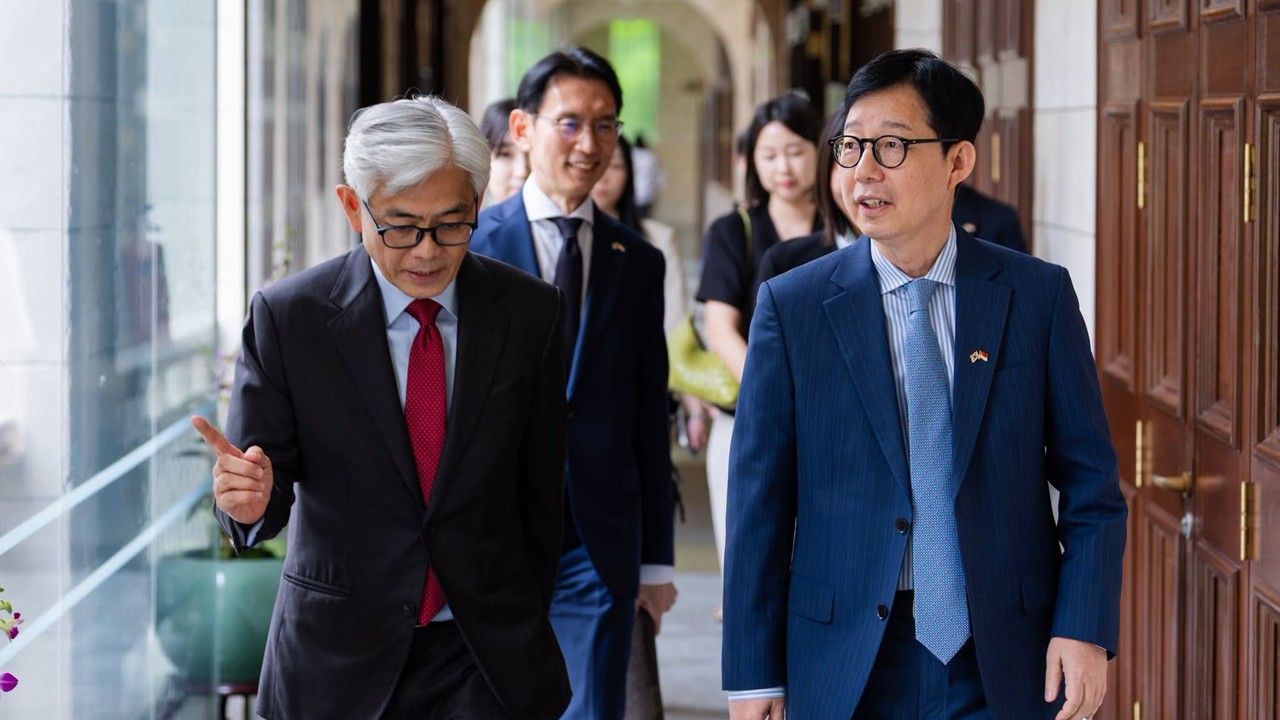
Singapore and South Korea have moved to strengthen their strategic partnership, with senior officials meeting in Singapore to review bilateral cooperation and identify new areas of collaboration spanning economic security, emerging technologies and regional diplomacy.
Singapore’s Permanent Secretary for Foreign Affairs, Albert Chua, co-chaired the first Singapore-Republic of Korea (ROK) Joint Steering Committee with South Korea’s First Vice Minister for Foreign Affairs, Park Yoonjoo, on 15 October 2026.
The meeting reviewed progress in implementing the two countries’ Strategic Partnership and reaffirmed their commitment to closer cooperation in trade and investment, the digital and green economies, public safety and security, and civil service exchanges.
Both sides also identified artificial intelligence (AI), cybersecurity and civil nuclear energy as emerging areas for cooperation, reflecting the growing intersection between economic competitiveness, technological development and national security.
The meeting comes as Singapore prepares to assume the chairmanship of the Association of Southeast Asian Nations (ASEAN) in 2027. Singapore will also become the bloc’s country coordinator for ASEAN-ROK Dialogue Relations for the 2027-2030 period, placing it in a position to help shape the regional agenda with South Korea.
The strategic partnership was established in November 2025, during Singapore Prime Minister Lawrence Wong’s official visit to South Korea, marking the 50th anniversary of diplomatic relations between the two countries. The upgrade provided a framework for broader collaboration in advanced technology, sustainability, energy and people-to-people exchanges.
During South Korean President Lee Jae Myung’s state visit to Singapore in March 2026, both governments reaffirmed their commitment to advancing cooperation in trade, energy and digital development. They also discussed upgrading the Korea-Singapore Free Trade Agreement and progressing negotiations on a bilateral nuclear cooperation agreement.
The energy dimension is particularly significant as both countries consider how to strengthen energy security while pursuing lower-carbon development. Singapore has been studying the potential role of nuclear energy in its longer-term energy mix, while South Korea brings established experience in nuclear technology. Cooperation in this area will depend on further negotiations, technical arrangements and the relevant safety and regulatory frameworks.
Digital cooperation is another priority, with both governments exploring opportunities in AI research and governance, cybersecurity and other emerging technologies. Such collaboration could support innovation and help businesses operate across increasingly interconnected digital markets.
The relationship also has a substantial economic foundation. According to South Korea’s Ministry of Foreign Affairs, bilateral trade reached US$30.9 billion in 2025. The ministry also reported 551,071 South Korean visitors to Singapore and 399,635 Singaporean visitors to South Korea that year, underscoring the scale of people-to-people links between the two economies.
Beyond bilateral relations, Singapore’s upcoming ASEAN responsibilities give the partnership a wider regional dimension. ASEAN and South Korea established a Comprehensive Strategic Partnership in 2024, expanding cooperation across political and security affairs, trade, digital transformation, energy, education and cultural exchanges.
At the 30th ASEAN-ROK Dialogue in Seoul in July 2026, senior officials reaffirmed their commitment to implementing the partnership’s 2026-2030 Plan of Action. South Korea also reiterated its support for ASEAN centrality in the evolving regional architecture.
Singapore’s role as ASEAN chair and country coordinator will provide an avenue to advance these priorities, including stronger economic links, digital transformation and cooperation on regional challenges.
For both countries, the immediate task is to translate high-level commitments into practical outcomes for businesses, institutions and citizens. The first Joint Steering Committee provides a mechanism to review implementation and sustain coordination across the expanding agenda.
The broader objective, according to Singapore’s foreign ministry, is to work with South Korea and regional partners in support of an open, inclusive and rules-based regional order at a time when economic resilience, technological change and security concerns are increasingly intertwined.