

Russia and China Deepen Strategic Ties as Agricultural Trade Surges 34%
Russian President Vladimir Putin and Chinese Premier Li Qiang have pledged to expand cooperation in energy, technology, space and agriculture, with bilateral agricultural trade rising 34% in the first eight months of 2026 as Moscow and Beijing prepare for another leaders' meeting in November.
ST PETERSBURG — Russia and China are seeking to deepen their strategic partnership across key economic and technological sectors, with Russian President Vladimir Putin highlighting a 34% increase in agricultural trade during the first eight months of 2026 following talks with Chinese Premier Li Qiang.
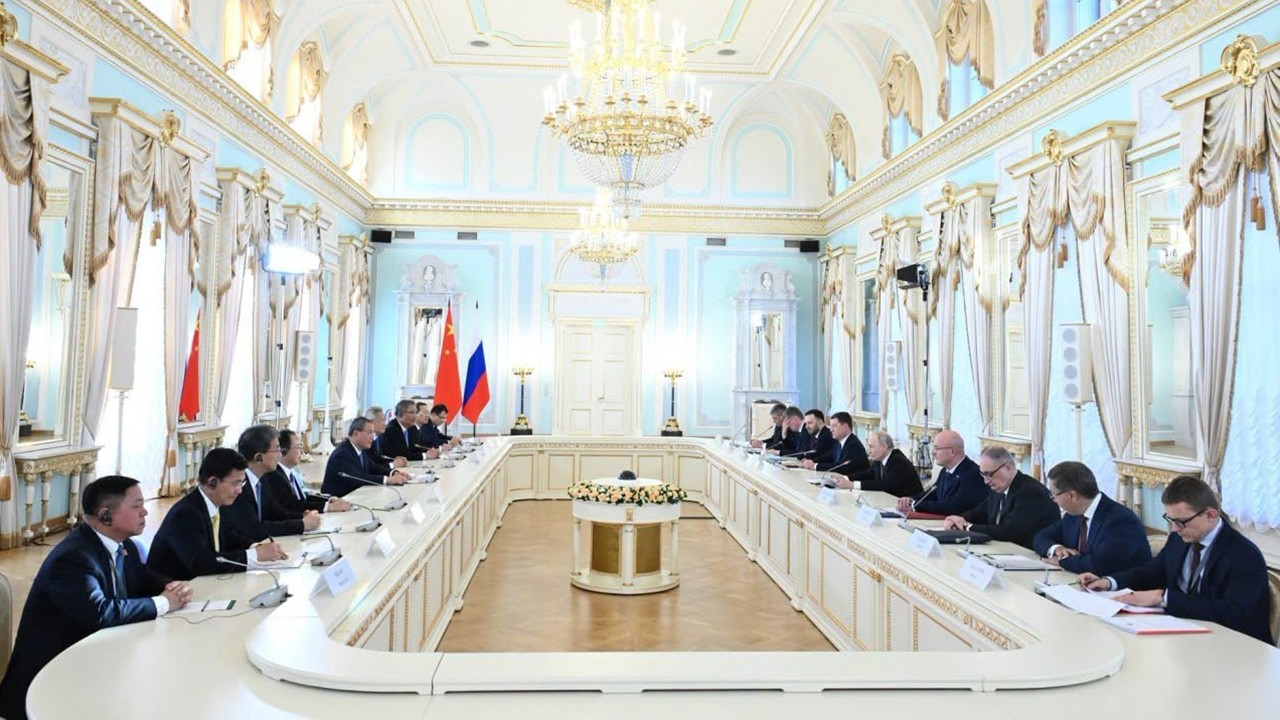
Putin met Li in St Petersburg on Wednesday, following the 31st regular meeting of Russian and Chinese heads of government, co-chaired by Li and Russian Prime Minister Mikhail Mishustin. The meeting underscored the role of both governments in implementing agreements reached during recent high-level engagements between Moscow and Beijing, as the two countries seek to expand their comprehensive partnership and strategic cooperation.
Putin welcomed Li and asked him to convey his best wishes to Chinese President Xi Jinping, noting that the two leaders had met three times in 2026 and were expected to meet again at the Asia-Pacific Economic Cooperation (APEC) Summit in Shenzhen in November.
The Russian president described bilateral relations as developing successfully, underpinned by equality, mutual respect, mutual benefit and consideration for each other's interests. He also said the relationship was not dependent on the international situation and was not directed against any other country, reiterating Moscow's position that cooperation with Beijing was based on shared interests rather than opposition to third parties.
Economic ties featured prominently in Putin's remarks, with both countries seeking to expand practical cooperation across energy, information technology, space and the peaceful use of nuclear energy.
Agriculture emerged as a particularly notable area of growth. Putin said trade turnover in the sector increased by 34% between January and August 2026, pointing to the growing importance of agricultural exchanges within the broader bilateral economic relationship.
However, he did not provide a monetary value for the increase or specify which commodities accounted for the growth.
The expansion comes as Russia and China continue to develop economic links across multiple sectors, giving agricultural trade a more prominent role alongside energy and industrial cooperation.
The two governments are also continuing cooperation in education and cultural exchanges. Putin said activities under the cross Years of Education, officially launched by the Russian and Chinese presidents in Beijing in May, were progressing successfully.
The education initiative reflects efforts to strengthen people-to-people links alongside government and commercial engagement, broadening the relationship beyond strategic and economic priorities.
Putin also acknowledged China's forthcoming Fifth Plenary Session of the 20th Central Committee of the Communist Party of China, scheduled for October 26 to 29, wishing Beijing success in conducting the important political meeting.
The latest discussions build on a longstanding mechanism for bilateral coordination between the two governments. Putin said the regular heads-of-government meeting had proved effective and valuable over three decades, providing a channel for translating agreements between the countries' leaders into practical cooperation.
The next major diplomatic milestone is expected to be the APEC Summit in Shenzhen in November, where Putin and Xi are scheduled to have another opportunity to meet. For both countries, the immediate task is to turn political commitments into further economic cooperation, with agriculture, energy and technology among the sectors highlighted by Moscow as priorities.
The latest meeting signals continued momentum in Russia–China relations at a time when both governments are emphasising strategic coordination and the expansion of trade and practical cooperation.