

“Standard Chartered Hong Kong SME Leading Business Index” Q4 2026
Overall Index Edges Up to 44.8 as Business Condition and Profit Margin Hit 2026 Highs, Over 90% of Cross-border SMEs Seek to Leverage Digital Tools, International Market Demand Emerges as a Key Growth Driver
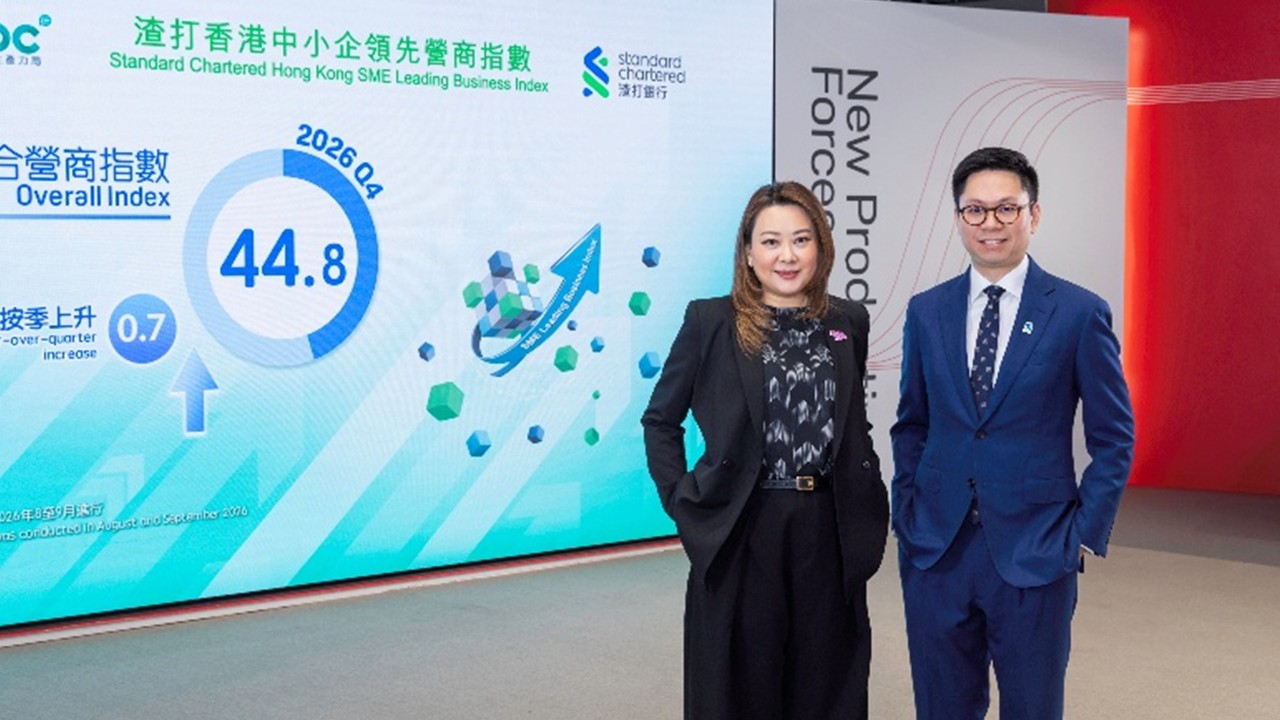
The Hong Kong Productivity Council (HKPC) today announced the “Standard Chartered Hong Kong SME Leading Business Index” (“Standard Chartered SME Index”) for the fourth quarter (Q4) of 2026. The survey results showed that the Overall Index recorded 44.8 this quarter, edging up by 0.7 from the previous quarter. “Business Condition” and “Profit Margin” sub-indices rebounded to 42.3 and 39.9 respectively, both reaching their highest levels this year. The findings reflected improved confidence among SMEs in their business and profit outlook, although overall sentiment remained cautious.
Among the five component sub-indices, “Business Condition” (42.3, +1.8) and “Profit Margin” (39.9, +2.1) rebounded, both reaching their highest levels this year. In the “Accommodation and Food Services” industry, both sub-indices rose markedly by 11.7, while the “Retail” industry also recorded improvements of 5.8 and 5.3 respectively. “Investment Sentiment” (50.8, +0.8) edged up and remained above the 50 neutral line. Meanwhile, “Recruitment Sentiment” (50.1, -0.4) stayed broadly stable, while “Global Economy” (31.5, -1.6) declined, indicating that SMEs remained cautious about the external economic outlook.
Regarding the changes in cost components, the proportion of SMEs expecting raw material costs to increase fell for the second consecutive quarter, dropping by 11 percentage points to 53%. The proportion anticipating staff salary increases also continued to decline, falling by 3 percentage points to 14%, indicating that pressures from rising costs and salaries continued to ease. Meanwhile, 20% of SMEs planned to raise the prices of their products or services, up slightly by 1 percentage point and remaining broadly stable overall.
The survey also examined the operating conditions and major challenges faced by SMEs that have established sales operations in other Greater Bay Area (GBA) cities. Results showed that these SMEs expected their overall revenue in other GBA cities to remain stable, with 70% anticipating no change. On costs, 34% expected operating costs to increase, down 5 percentage points from the previous quarter, indicating some easing in cost pressures. Among those still expecting higher costs, raw material / procurement costs and staff salaries were the main drivers. Intense market competition remained the leading challenge, with the proportion rising from 41% to 47%, followed by differences in customer demand between Hong Kong and the Chinese Mainland, regulatory differences / compliance requirements, and customs clearance procedures / cross-border logistics.
Mr Tommy WU, Senior Economist, Greater China and North Asia, Standard Chartered, said, “The ‘Standard Chartered SME Index’ picked up for the second consecutive quarter in Q4. The increase was mainly supported by improvements in the near-term outlook for sales and profit margins, while investment sentiment rose, pointing to an increase in confidence on the long-term outlook. Hong Kong’s external trade activity continues to benefit from the global AI supercycle, driving the ‘Import / Export Trade and Wholesale’ industry index up for two consecutive quarters, by a cumulative 3.4 points to 42.8, its highest level in two years. Rising number of business and entertainment events, together with the continued recovery in inbound tourism, have boosted confidence across ‘Retail’ and ‘Accommodation and Food Services’ industries. Meanwhile, record IPO fundraising in the first three quarters of the year has provided strong support to the financial and professional services sector. While the financial and insurance services industry continues to monitor developments relating to stricter cross-border fund flow regulations, sentiment of the surveyed firms in the industry largely held up, suggesting that the impact on business activity should remain manageable. While sentiment in the ‘Real Estate’ industry has softened, market outlook in the ‘Construction’ industry has shown modest improvement. Looking ahead, positive outlook surrounding the Northern Metropolis development may provide further support to business confidence.”
Thematic Survey Results: Hong Kong SMEs’ Cross-border Business Development and Digitalisation Plans
The thematic survey of this quarter explored Hong Kong SMEs’ views and plans regarding cross-border business development. The survey revealed that around one-third (32%) of surveyed SMEs are currently engaged in cross-border business or plan to expand cross-border operations within the next year. By industry, “Manufacturing” recorded the highest proportion at 82%, followed by “Transportation, Storage and Courier Services” (56%) and “Import / Export Trade and Wholesale” (44%).
Among SMEs planning to expand into cross-border business within the next year, the Chinese Mainland (49%) and Asian markets (42%) were the most preferred destinations. ASEAN was among the Asian markets most commonly considered by SMEs, while some were also considering expansion into Europe, the Americas and the Middle East. When selecting target markets, SMEs mainly considered market demand and growth potential, existing customer bases or business networks, and operating costs.
Ms Karen FUNG, Chief Marketing Officer of HKPC, said, “As the Chinese Mainland, ASEAN and other overseas markets continue to unlock growth potential, more SMEs are viewing cross-border business as an important strategy for reaching new customers and diversifying market risks. Through ‘The Cradle – Go Global Service Centre’, HKPC has observed that enterprises that succeed in expanding across borders look beyond market size and place greater emphasis on understanding local customer needs, regulatory environments and operating models. By preparing their market strategies early and leveraging Hong Kong’s advantages in connecting the Chinese Mainland and international markets, enterprises will be better positioned to capture cross-border opportunities and strengthen business resilience.”
Digitalisation has also become an important enabler of SMEs’ cross-border expansion. More than 90% of SMEs currently operating cross-border business indicated that they would like to leverage digital tools to support their cross-border operations. The most commonly used tools included social media marketing, cross-border payment and remittance platforms, and AI tools. In terms of practical applications, SMEs most wanted digital tools to help them find overseas customers and business opportunities, followed by marketing and brand promotion, and market intelligence and data analytics.
Looking ahead to the next three years, among SMEs currently operating or planning to expand into cross-border business within the next year, 48% believed that growth in international market demand would support cross-border business development. This was followed by government support measures (38%), opportunities arising from regional economic cooperation (34%), and the adoption of AI and digital technologies (31%), reflecting that market demand, policy support and technology adoption will be key drivers of SMEs’ overseas expansion.
Karen added that as models of cross-border business development continue to evolve, SMEs are no longer relying solely on traditional trade fairs or physical sales channels to “go global.” Instead, they are placing greater emphasis on using digital channels to build brands, reach customers and stay abreast of market trends. The role of digital tools has expanded from improving operational efficiency to supporting market expansion and business decision-making. HKPC will continue to serve as a key enabler of SMEs’ digital transformation and AI adoption, helping enterprises enhance their digital capabilities and competitiveness through technology adoption, transformation support and talent development, while empowering them to seize new opportunities in cross-border and overseas business expansion.
Conducted in August and September 2026, the Standard Chartered SME Index Q4 2026 survey successfully interviewed 820 local SMEs, with an additional 24 local SMEs that have expanded into other GBA cities as booster samples for further analysis. The report will be available for download from HKPC website: https://www.hkpc.org/en/about-