

Three Large Asia-Pacific Enterprises Will Face Shadow AI Agent Risks
Unauthorised employee-built AI agents could outnumber officially approved systems by at least 10 to one at a third of large Asia-Pacific enterprises, exposing organisations to security breaches, governance gaps and mounting technical debt, according to Forrester's 2027 regional predictions.
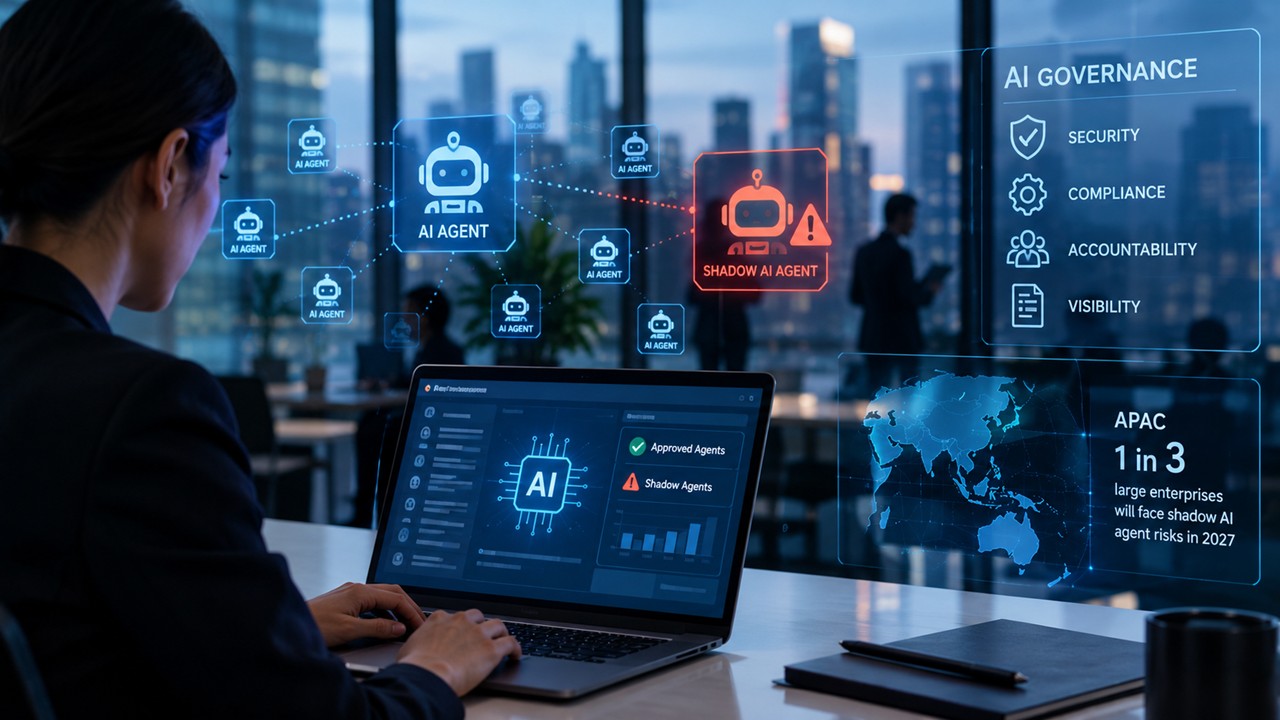
SINGAPORE — One in three large enterprises in Asia-Pacific will uncover at least 10 employee-built artificial intelligence agents for every officially sanctioned agent in 2027, highlighting the growing challenge of controlling AI adoption across corporate environments, according to research firm Forrester.
The proliferation of so-called shadow AI agents — automated systems developed or deployed by employees without formal organisational approval — is expected to outpace institutional controls as businesses experiment with new tools, adopt AI features embedded in software and select platforms independently.
Forrester warned that the trend could create a new form of AI-driven technical debt, characterised by unmanaged risks, duplicated capabilities, weakened governance and undocumented dependencies.
The findings form part of the company's 2027 Asia-Pacific predictions, which point to a shift in corporate priorities from the speed of AI deployment towards effective oversight, accountability and risk management.
As AI systems increasingly operate across organisational boundaries and interact with corporate data, applications and credentials, businesses face the challenge of ensuring that these tools remain within acceptable security and governance frameworks.
Forrester also expects one in five large regulated enterprises to approve Chinese open-weight AI models in 2027, reflecting a growing emphasis on technological sovereignty and greater control over how and where AI systems operate.
Open-weight models allow organisations to access and modify key model components, potentially enabling them to host AI systems within their own infrastructure and exercise greater control over deployment and inference.
According to Forrester, these capabilities could make self-hosted Chinese models attractive to enterprises seeking operational independence, even as questions about model provenance and geopolitical considerations remain.
The forecast highlights the increasingly complex decisions facing Asia-Pacific organisations as they balance technological capabilities, data governance, security requirements and national or regional sovereignty concerns.
Another prediction warns that a personal AI agent used by an employee could trigger a security incident at a Fortune 500 company.
As consumer AI adoption grows, employees may introduce personal agents into the workplace to carry out tasks involving corporate devices, credentials and data. While these agents may be designed to perform legitimate activities, their access to sensitive systems could create unintended consequences.
Forrester said existing security controls typically focus on verifying identities and permissions rather than determining an AI agent's intent or how it might use its authorised access. This could leave organisations vulnerable to data exposure or misuse when autonomous systems act in unexpected ways.
The issue adds urgency to the need for businesses to establish clear policies governing employee use of AI agents, including access restrictions, monitoring, accountability and the handling of confidential information.
The research also forecasts that 10 of Asia-Pacific's largest consumer-facing brands will distinguish themselves through what Forrester calls human assurance.
As companies introduce AI-driven personalisation and automated customer services, leading brands are expected to retain human oversight for interactions involving significant financial consequences, emotional vulnerability or complex decisions.
Financial services and healthcare are among the sectors where access to human experts and licensed advisers is likely to remain important, particularly when customers require professional judgement, reassurance or accountability beyond what automated systems can provide.
The prediction suggests that competitive advantage in an AI-driven economy will depend not only on automation and personalisation but also on maintaining customer confidence through meaningful human involvement.
Frederic Giron, Forrester's vice-president and senior research director, said Asia-Pacific organisations would need to develop governance approaches suited to a region with diverse markets, regulatory requirements and levels of AI readiness.
Companies that adapt governance to local sovereignty requirements while investing in long-term customer trust and organisational resilience will be better positioned to capture AI's value, he said.
Forrester's outlook places AI governance alongside cybersecurity, technological sovereignty and customer trust as strategic priorities for the coming year. For business leaders, the challenge will be to support innovation without allowing independently deployed systems to undermine corporate controls.
As AI agents become more capable and accessible, organisations will need clearer visibility over which systems are operating, what information they can access and who is accountable for their actions.
The predictions were released as part of Forrester's 2027 research programme, which provides forward-looking analysis for business, technology, marketing and security leaders.
Forrester is a global research and advisory firm serving leaders across technology, customer experience, digital, marketing, revenue and product functions.