

Myanmar's rare earth chemical trail exposes the hidden cost of China's critical minerals supply chain
Rising imports of ammonium sulphate and oxalic acid could provide clues to the expansion of Myanmar's largely unregulated rare-earth mining industry, supplying minerals essential to electric vehicles, aviation, defence and advanced manufacturing. But the extraction process is leaving a growing environmental footprint, with pollution crossing into neighbouring Thailand.
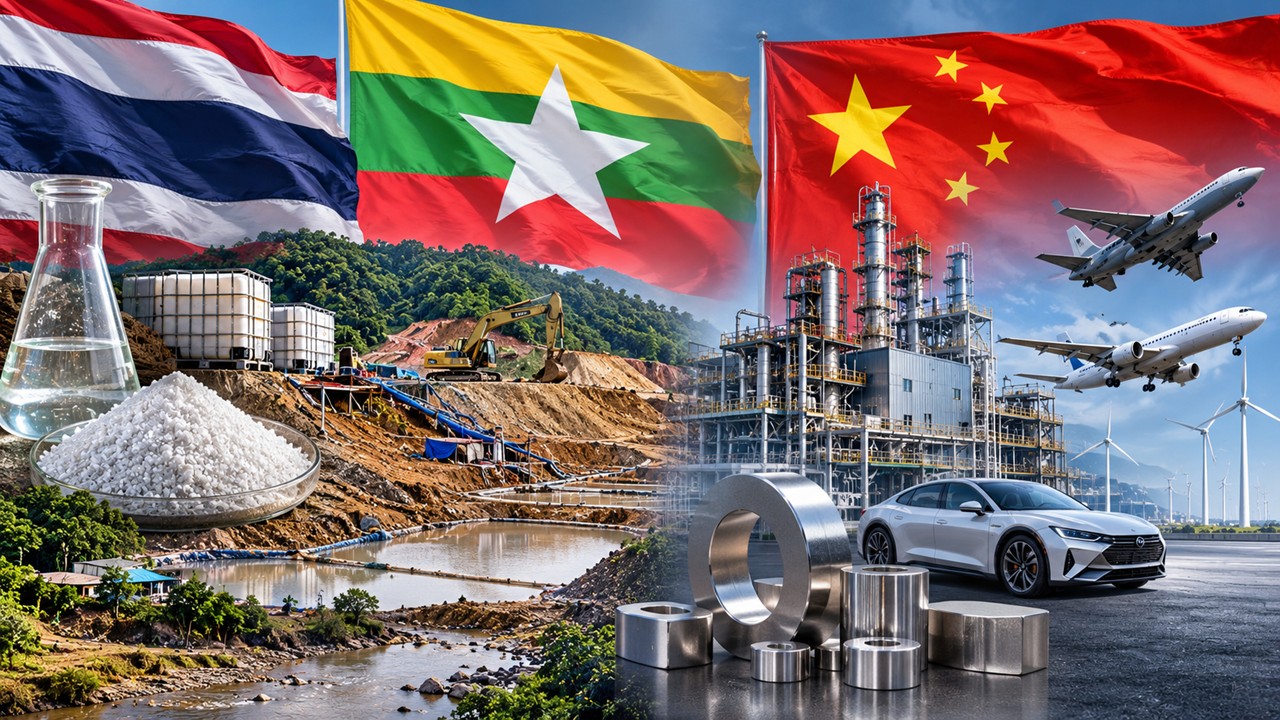
Myanmar's expanding rare-earth industry is creating an increasingly important supply chain for China, but the chemicals used to extract the minerals could also offer a way to measure the scale of mining that is difficult to monitor directly.
Trade figures compiled by Global Witness show that China's ammonium sulphate exports to Myanmar increased from 93,000 tonnes in 2015 to 1.5 million tonnes in 2023. Over the same period, exports of oxalic acid rose from just 342 tonnes to 174,000 tonnes.
The figures do not establish how much of these chemicals was used in mining, as both have other industrial applications. However, the dramatic increase provides an important indicator of the growth of chemical-intensive extraction operations, particularly when compared with satellite imagery of mining sites and Myanmar's rare-earth exports to China.
A systematic comparison of chemical imports, mining-site expansion and mineral shipments could help researchers estimate the scale of an industry operating in areas where regulatory oversight is weak and production figures are difficult to verify.
The issue has implications well beyond Myanmar and China. Rare-earth elements are essential to modern manufacturing, particularly the high-performance permanent magnets used in electric vehicle motors, wind turbines, industrial automation, aerospace systems and defence equipment.
The International Energy Agency identifies neodymium, praseodymium, dysprosium and terbium as particularly important magnet rare earths. These materials help produce powerful magnets that can operate in demanding conditions, including the high temperatures and performance requirements associated with advanced motors and aerospace applications.
Their importance is reflected in the concentration of the global supply chain. China accounted for 91 per cent of refined magnet rare-earth production and 94 per cent of permanent magnet manufacturing in 2024, according to the IEA.
Myanmar's role is primarily at the extraction end of this chain, with much of its heavy rare-earth output moving across the border into China for processing.
Understanding the environmental consequences requires looking at how the minerals are extracted. In many of Myanmar's deposits, miners use a technique known as in-situ leaching, particularly in ion-adsorption clay deposits. Rather than excavating large quantities of ore, operators drill holes into hillsides and inject a chemical solution, commonly ammonium sulphate, into the ground.
The solution moves through the clay, displacing rare-earth ions attached to mineral particles. The resulting liquid, carrying dissolved rare-earth elements, is collected through drainage channels and pools lower down the hillside.
The material is then processed to recover the minerals. Oxalic acid can be used to precipitate rare-earth compounds from the solution, producing a solid material that can subsequently be treated and converted into mixed rare-earth products.
Although this approach can be relatively inexpensive and allows miners to access deposits without conventional large-scale excavation, poorly controlled operations can cause extensive environmental damage.
Leaching solutions can escape into surrounding soil and waterways, while the disturbance of mineral-bearing ground can mobilise naturally occurring contaminants. Wastewater, chemical residues and improperly managed tailings can contaminate streams, rivers and agricultural land.
Global Witness has documented the environmental consequences of these operations in northern Myanmar, including chemical exposure among workers and damage to water sources and surrounding communities.
The problem is particularly concerning in parts of Kachin State, where extensive heavy rare-earth mining has developed close to the Chinese border. More recently, mining expansion in Shan State has drawn attention because of contamination concerns affecting river systems flowing into Thailand.
The Kok and Sai rivers, which flow from Myanmar into northern Thailand, have become central to a growing environmental dispute. Thailand has linked contamination in these waterways to mining activities upstream and is seeking to strengthen monitoring and pollution controls.
Bangkok's proposed restrictions on exports of chemicals used in rare-earth mining are therefore an attempt to intervene further up the supply chain, before pollution reaches Thai territory.
The proposal, announced by Deputy Prime Minister Yodchanan Wongsawat, comes ahead of discussions involving Thailand, China and Myanmar scheduled for November 24 to 26. The Thai government has not yet published a definitive list of restricted chemicals or fully detailed how the proposed controls would operate.
For China, the relationship with Myanmar serves a different purpose.
The minerals extracted in Myanmar are generally transported across the border to Chinese processors, where the mixed rare-earth material undergoes more sophisticated chemical separation and refining. The individual rare-earth elements are separated into high-purity oxides, which can then be converted into metals, alloys and permanent magnets.
These magnets ultimately enter manufacturing supply chains serving electric vehicles, renewable energy, industrial machinery, electronics, aerospace and defence industries.
China's dominance is not simply a result of possessing mineral resources. Its extensive refining, metallisation and magnet-manufacturing capabilities give it control over the stages that turn raw materials into high-value industrial components.
The IEA has warned that this concentration creates significant vulnerabilities. Export restrictions introduced by China in 2025 disrupted supplies of certain heavy rare-earth materials and magnets, forcing manufacturers in several countries to reassess their sourcing arrangements.
Myanmar's mines consequently occupy an important position in a global supply chain whose strategic significance extends from the energy transition to national security. The challenge is that the environmental costs of extraction are often borne by communities far removed from the industries that ultimately use the finished products.
Tracking chemical imports could help expose the scale of this activity, but it would need to be combined with satellite monitoring, mine-level investigations and trade data on Myanmar's exports to China. Ammonium sulphate, for example, is also widely used as fertiliser, meaning that total imports cannot simply be converted into tonnes of rare earths produced.
Nevertheless, the chemical trail offers a potentially valuable means of investigating an industry whose growth has outpaced environmental oversight. The question is no longer simply where the world's rare earths are coming from. It is whether the industries and countries benefiting from these strategic minerals can account for the environmental and human costs of producing them.