

Singapore deepens China connectivity with new Tianjin-Xiong'an economic corridor
Singapore and China have agreed to develop a new economic corridor linking Tianjin and Xiong'an New Area with the wider Jing-Jin-Ji region, as the two countries deepen cooperation in aviation, maritime connectivity, digital trade and regional supply chains, reinforcing Singapore's position as a gateway for Chinese businesses entering Southeast Asia.
SINGAPORE - Singapore is strengthening its position as a gateway for Chinese businesses seeking opportunities in Southeast Asia, following a series of agreements with China that expand economic and transport connectivity between the two countries and their respective regions.
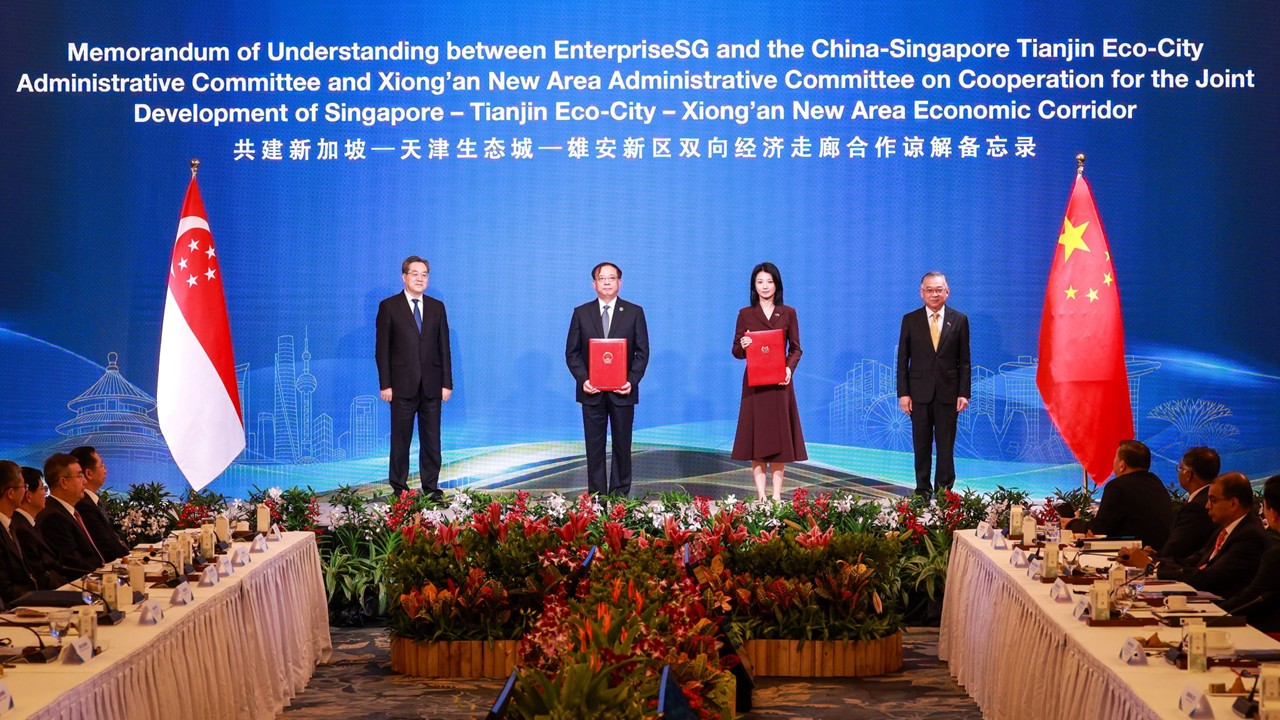
The development was among the key outcomes of the 22nd Joint Council for Bilateral Cooperation (JCBC), co-chaired by Singapore Deputy Prime Minister Gan Kim Yong and Chinese Vice Premier Ding Xuexiang in Singapore on November 23.
One of the significant announcements was a memorandum of understanding on the joint development of the Singapore-Tianjin Eco-City-Xiong'an New Area Economic Corridor, creating a framework for stronger commercial links between Singapore and China's Jing-Jin-Ji economic region, which encompasses Beijing, Tianjin and Hebei province.
The initiative is intended to create opportunities for businesses on both sides, with Tianjin companies encouraged to use Singapore as a platform to expand into Southeast Asia, while Singapore businesses gain access to opportunities in Tianjin and the wider northern Chinese market.
Singapore Senior Minister of State for Transport and National Development Sun Xueling highlighted the importance of transport connectivity in supporting the longstanding bilateral relationship, noting that cooperation with China's Ministry of Transport, Civil Aviation Administration of China and China Maritime Safety Administration had helped strengthen aviation and maritime links.
In aviation, the two countries are working to improve connectivity and provide airlines with greater certainty in planning their operations. This includes improved timings for Singapore Airlines' Chongqing services from November 22, 2026, as well as early assurance of airport slots for Singapore airlines for the next scheduling season.
Maritime cooperation is also advancing through the Singapore-China Green and Digital Shipping Corridor, which aims to promote greener shipping operations and digital solutions across maritime supply chains.
The corridor is part of a wider effort to improve the efficiency and sustainability of shipping while strengthening Singapore's connections with Chinese ports and logistics networks.
The JCBC also delivered 29 memoranda of understanding and agreements, covering traditional areas such as trade, finance and education, alongside emerging sectors including artificial intelligence, digital trade, healthcare, science and innovation, low-carbon energy and public health.
Another important development was the agreement to begin negotiations on upgrading the China-Singapore Free Trade Agreement, known as CSFTA 4.0. The proposed upgrade will include a digital economy component aimed at facilitating cross-border data flows and supporting businesses operating in increasingly interconnected markets.
Financial connectivity also featured prominently, with both sides welcoming stronger renminbi cooperation and exploring links between fast payment systems to facilitate smaller-value cross-border transactions.
Food security was another area of progress, with Singapore approving China's Hainan province for the export of poultry, pork and eggs, broadening Singapore's food supply options.
The discussions also covered the development of the three flagship government-to-government projects that have shaped bilateral cooperation: the Suzhou Industrial Park, Tianjin Eco-City and China-Singapore (Chongqing) Demonstration Initiative on Strategic Connectivity.
The Tianjin Eco-City, established in 2008, is now home to approximately 200,000 residents. Both countries are looking to expand cooperation beyond urban development and infrastructure into research and innovation, economic development, housing and people-to-people exchanges.
The wider Jing-Jin-Ji initiative represents a new phase in that relationship, with Singapore seeking to connect its established business networks and Southeast Asian market access with one of China's key economic development regions.
The Chongqing Connectivity Initiative is meanwhile being developed further to strengthen links between Southeast Asia, western China and Central Asia through the New International Land-Sea Trade Corridor.
The wider economic implications extend beyond the immediate bilateral relationship, as stronger connectivity between Singapore and northern China could generate spillover opportunities for businesses across Southeast Asia through investment, logistics, financial services, manufacturing and supply-chain integration.
However, the success of these corridors will also depend on maintaining a stable and predictable regional environment. For businesses making long-term investment decisions, security is not limited to physical infrastructure but also encompasses maritime stability, reliable transport routes, secure digital networks, regulatory certainty and the protection of cross-border trade.
As geopolitical competition and regional tensions reshape commercial calculations, Singapore's ability to provide a trusted business environment and maintain strong diplomatic and economic relationships with major trading partners remains an important part of its value proposition.
For Singapore, these initiatives reflect a strategy of building multiple economic and logistics connections into China while maintaining its role as an international trading, financial and business hub.
The November meeting also reaffirmed the two countries' commitment to free trade, multilateralism and a rules-based international order amid an increasingly uncertain global economic environment.
The breadth of the agreements suggests that Singapore-China cooperation is moving beyond its traditional focus on industrial parks and infrastructure towards a more integrated relationship encompassing digital commerce, financial services, sustainable logistics, technology and regional market access.