Where Colour Becomes a Language
Malaysian self-taught artist May Ismail has spent more than two decades turning colour, texture and personal expression into a continuing artistic journey, moving from still life and landscapes into modern abstraction and expressive floral works.
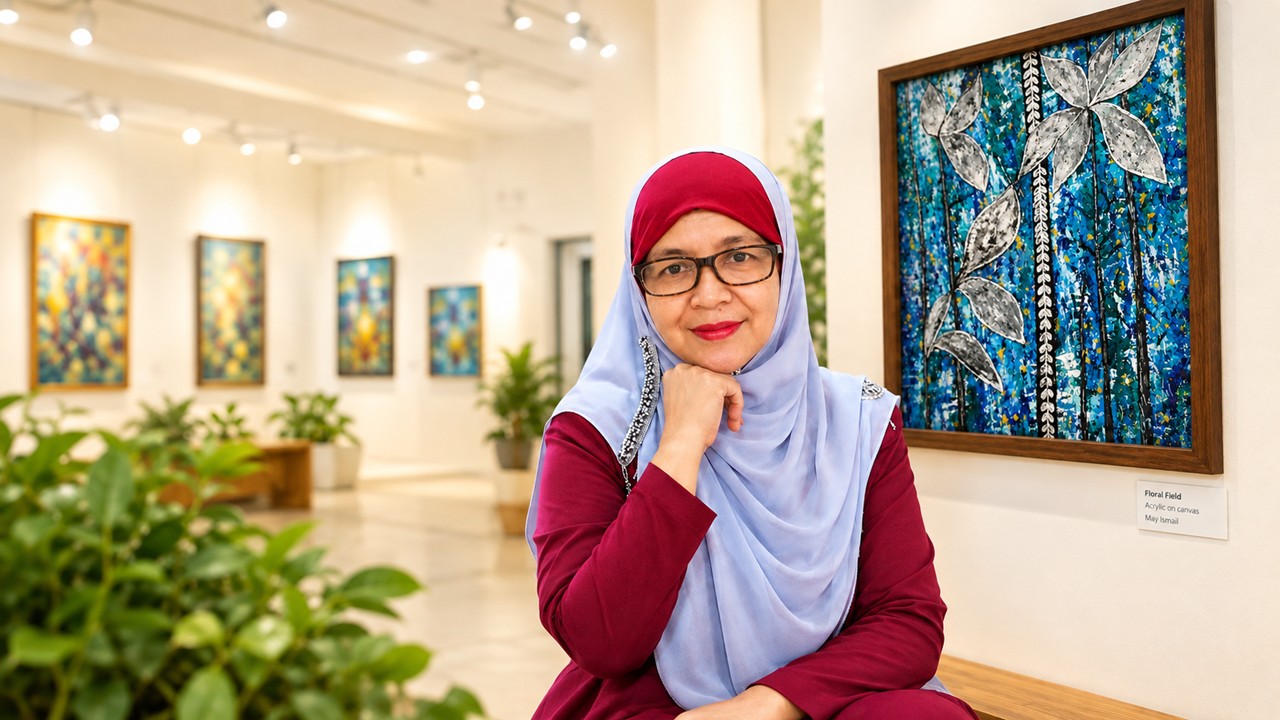
For May Ismail, painting began not with formal training or a lifelong ambition to become an artist, but with a feeling that returned after many years.
Born in 1960, Ismail first encountered art as a school subject during her younger years. It was only in 2004 or 2005 that she felt the desire to return to painting, prompting her to attend several art lessons at Galeri PETRONAS and begin a creative journey that has continued for more than two decades.
What started as an attempt to refresh skills from her younger days gradually became something much more personal. Painting became a form of expression, creativity and, in her words, a kind of stress therapy. From the canvas, she found a space where emotions could be translated into colour, texture and movement without necessarily having to be explained in words.
Her early works explored familiar subjects including still life, flowers, scenery and landscapes. Over time, however, her artistic language developed towards modern abstract oil and acrylic painting, with abstract flowers and expressive compositions becoming an important part of her practice.
For May Ismail, colour sits at the heart of that process. She describes painting as being about “passion, colours and creativity”, with each artwork providing an opportunity to express something personal. Rather than following a fixed artistic formula, she continues to explore different techniques and subjects, allowing her work to evolve through experimentation.
Her interest also extends beyond conventional Malaysian artistic references. Among the influences she has explored are Aboriginal Australian paintings, adding another dimension to an artistic journey that remains deliberately open to different visual languages.
The physical process of making each painting is equally important. Ismail works with high-quality acrylic paints and mediums on professional stretched canvas, using brushes, palette knives and, at times, her fingers to create texture. Layers are built across the surface, allowing the paint itself to become part of the visual expression.
Each completed work is personally signed on the front and, according to the artist, is a one-of-a-kind original. That emphasis on individuality is central to how Ismail approaches art. Her paintings are not produced as reproductions of a predetermined formula but emerge from an ongoing relationship between colour, technique and feeling.
There is also a sense of continuity in her practice. Even after more than 20 years of painting, May Ismail does not regard her artistic journey as complete. She continues to learn new techniques and experiment with new approaches, seeing the process of becoming an artist as something that does not have a final destination.
For a self-taught artist, that willingness to keep learning has become part of the identity of her work. Her journey also reflects a wider reality within Malaysia’s contemporary art landscape, where artists increasingly develop their practices outside conventional academic pathways. Independent artists can build their visual language through workshops, observation, experimentation, exhibitions and years of sustained personal practice.
Recently exhibiting at the Art Market Malaysia, which was founded by Rita Hatta, has become the market for original art is increasingly shaped not only by established names and formal gallery representation, but also by collectors seeking works with a personal story and a distinctive artistic voice.
For emerging and independent artists, originality can be an important part of that proposition. A one-of-a-kind hand-painted work offers collectors something different from mass-produced decorative art, particularly when the artist's process and personal journey form part of the story behind the canvas.
This is where artists such as Ismail occupy an interesting space. The growing interest in contemporary and independent Malaysian artists also provides a broader platform for artists who have developed their practices outside traditional art-school routes.
For collectors, the appeal can extend beyond the canvas itself. The artist's story, the techniques used, the originality of the work and the connection between the artwork and its creator can all contribute to its value and meaning.