

Indonesia needs a free and active economic policy
Indonesia’s fixation on the rupiah–US dollar exchange rate has made monetary policy too responsive to US and global conditions, leaving domestic activity to absorb external shocks. Proposals to restore a formal peg may appear attractive amid rupiah weakness, falling reserves and deteriorating investor confidence, but Indonesia lacks the reserves, fiscal credibility and institutional strength needed to sustain one. A better approach would follow the bebas dan aktif principle that guides Indonesia’s foreign policy — free from the US dollar and active in responding to domestic inflation and economic conditions.
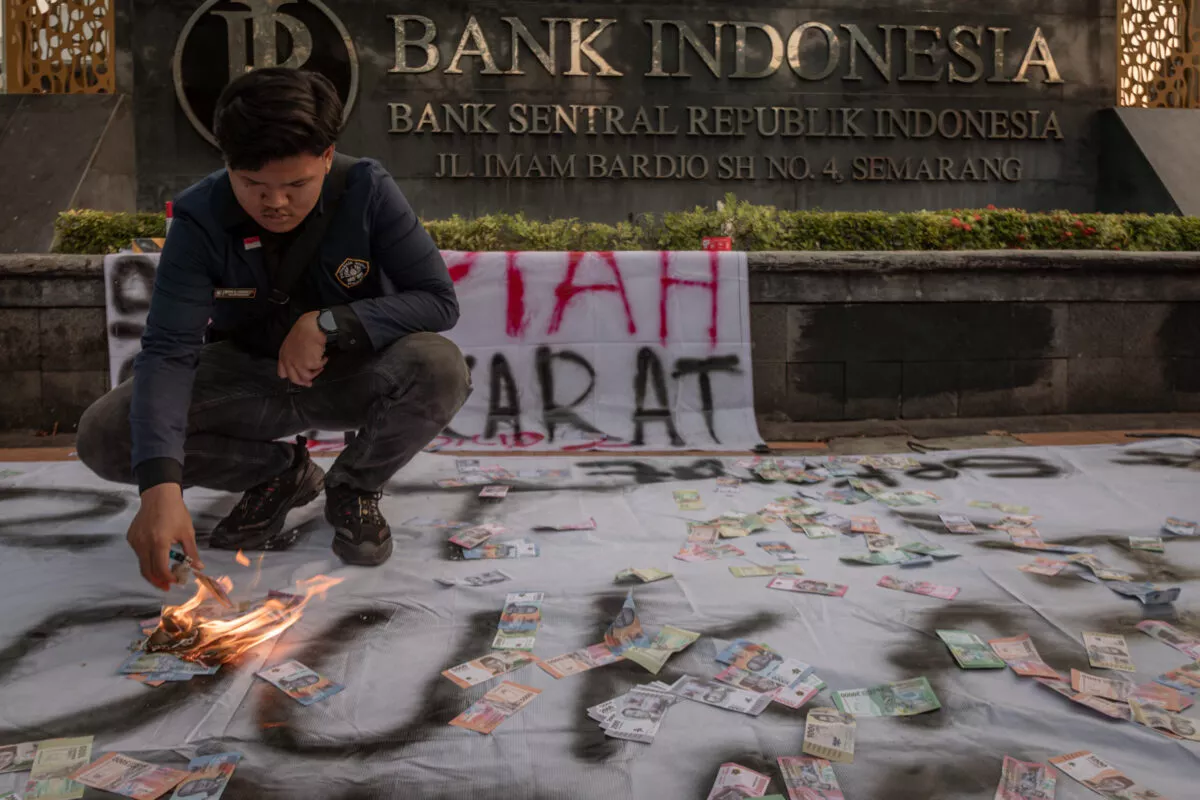
The slogan ‘free and active’ (bebas dan aktif) has guided Indonesia’s foreign policy since the country declared independence in 1945. Indonesia’s monetary policy should follow the same principle — free by delinking from the US dollar and active by targeting domestic economic conditions.
Indonesia’s fixation on the rupiah–US dollar exchange rate has triggered policy responses that are governed by US and global conditions. A rising US dollar has repeatedly been a barometer of stress in the Indonesian economy, including in 2013, when the US Federal Reserve’s suggestion that it would scale back quantitative easing caused capital outflows from Indonesia and other emerging markets. Similar pressures returned with the soaring dollar in 2023 and again in 2026 amid the Iran war.
The dollar fixation has driven a de facto policy of a loose peg to the US dollar. This means that economic activity bears the brunt of economic shocks, rather than a flexible exchange rate absorbing them. Tighter monetary conditions, prompted by a rising US dollar, raise market interest rates, hurting activity even when inflation may be falling and demand is weak.
Indonesia’s announced policy interest rate is symbolic. The deviation of the policy rate from short-term market interest rates makes that clear. Monetary policy is instead conducted by setting liquidity conditions to target a steady rupiah–dollar exchange rate. This liquidity goal means the announced interest rate cannot also function as a policy instrument.
Senior political leaders have hinted at returning Indonesia to a pegged exchange rate regime. At first glance, the appeal is obvious. The rupiah has weakened, reserves have fallen and investor confidence has deteriorated. A fixed exchange rate appears to offer certainty and a clear signal that policymakers intend to stabilise financial conditions.
In fact, this move would make Indonesia more vulnerable to financial stress. The more Indonesia has sought to stabilise the rupiah–dollar exchange rate, the more it has felt compelled to introduce costly measures — including market intervention, new financial instruments and capital controls — that have sown the seeds of rupiah instability.
Investors have exited Indonesia’s foreign exchange market because they see the rupiah as depending on the diminishing capacity of the central bank, Bank Indonesia, to prop up its nominal value. This leaves Indonesia with a small and illiquid foreign exchange market where the central bank is the primary supplier of dollars for rupiah.
The wrong message is being drawn from Indonesia’s economic history. Advocates invoke the era of former president Suharto as evidence that a pegged exchange rate can deliver stability and growth. But for most of that period, Indonesia did not operate a rigid fixed exchange rate. It used a crawling peg that was periodically adjusted when competitiveness deteriorated.
The lesson from the Suharto era is the opposite of the one being claimed. The policy objective was not to defend a particular number, but to preserve competitiveness and stability. The regime’s success was a result of its flexibility, periodic adjustment and policy discipline — a coherent macroeconomic framework grounded in fiscal rules, external sustainability and economic realism. The exchange rate was one instrument among many, not an objective in itself.
Even so, Indonesia in 2026 lacks the conditions required to sustain a credible peg. Successful pegs require large foreign exchange reserves, strong investor confidence, fiscal discipline, credible institutions and, often, restrictions on capital mobility. Indonesia struggles on most of these fronts. Usable reserves have been declining, confidence in Indonesian assets is weak and questions persist about the coherence of the broader policy framework. Fiscal risks are similarly increasing as government activity expands beyond the traditional budget.
A government can announce an exchange rate, but it cannot compel markets to believe it. Introducing a peg when confidence is already fragile risks further unsettling markets. Rather than stabilising expectations, it focuses attention on whether authorities can defend the chosen rate. If investors conclude they cannot, then the peg becomes a one-way bet. The result is capital outflows, reserve depletion and ultimately a forced adjustment.
A credible peg would also require administratively challenging capital controls. But even if capital controls were feasible, their use would clash with other goals. Indonesia is dependent on foreign capital, external confidence and access to international markets. The budget relies on offshore financing. Capital controls would risk damaging the very flows Indonesia depends upon, raising borrowing costs and crowding out private investment. Pressure would increase on Bank Indonesia to support government financing. The institutional credibility required to sustain the peg would erode.
A bebas dan aktif economic policy would be disciplined, but supportive of Indonesia’s domestic economic conditions. The government would strengthen fiscal credibility through transparency and a medium-term fiscal framework, restore a clear monetary policy anchor focused on domestic stability and rebuild confidence through deeper and more effective financial markets. The regime would be bebas — free or independent — because it would delink monetary policy from the dollar. It would be aktif — active — because policy would respond to Indonesia’s inflation prospects and economic activity.
Indonesia’s challenge is not to defend a particular exchange rate. It is to build a policy framework that is independent in its objectives, active in its response to changing conditions and credible enough to earn the confidence of markets and citizens alike. That was true under Suharto, and it is true today.
David Nellor is Senior Fellow at the Lowy Institute. He has lengthy experience in economic policy and international development, including as the Director of Australia’s economic governance program in Indonesia and as a Senior Advisor at the International Monetary Fund.