

China Keeps Southeast Asia in Focus
China's engagement with Cambodia and Thailand highlights Beijing's determination to remain actively involved in Southeast Asia, where deepening trade, investment and infrastructure links make regional stability an important economic and strategic priority.
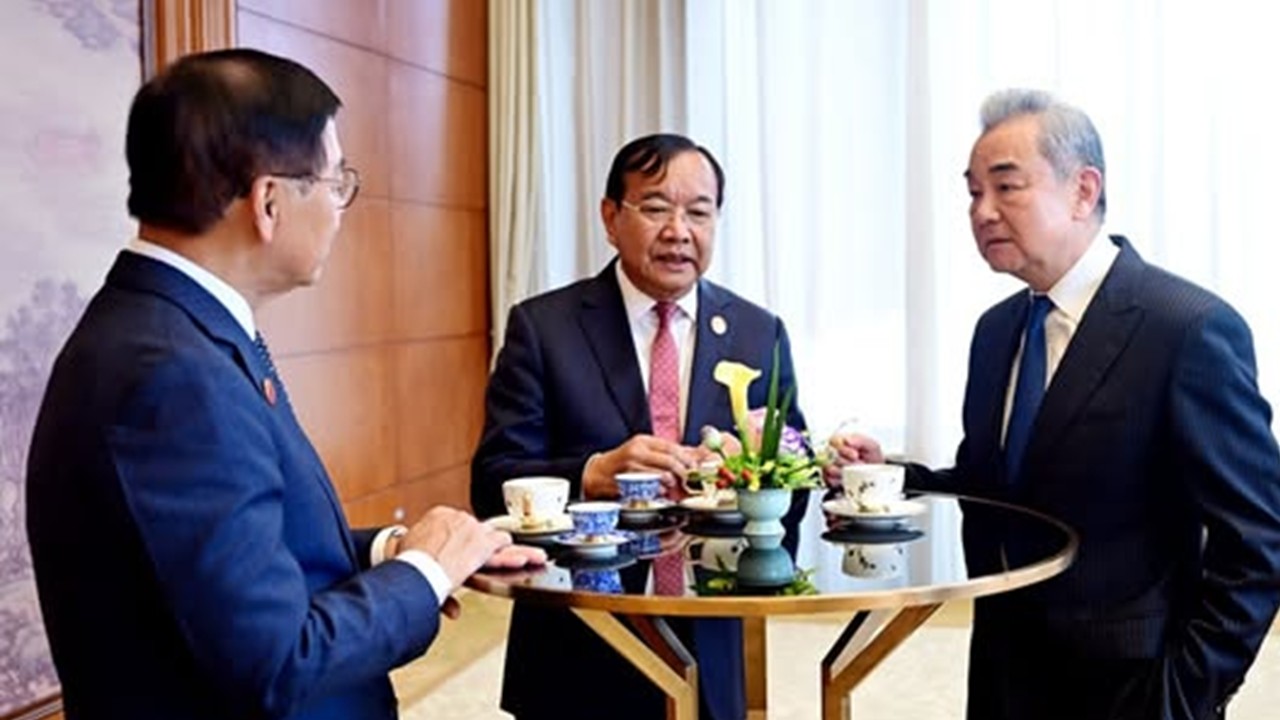
Wang Yi's meeting with the Cambodian and Thai foreign ministers underscores Beijing's continued diplomatic engagement with Southeast Asia, where its economic interests, trade relationships and strategic investments give it a significant stake in regional stability.
China's continued engagement with Southeast Asia was evident on November 4, when Foreign Minister Wang Yi hosted Cambodian Deputy Prime Minister and Foreign Minister Prak Sokhonn and Thailand's Deputy Prime Minister and Foreign Minister Sihasak Phuangketkeow for an informal tea meeting in Beijing. Held on the sidelines of the 11th Lancang-Mekong Cooperation Foreign Ministers' Meeting, the discussions focused on strengthening cooperation, regional stability and confidence-building measures between Cambodia and Thailand.
The meeting comes at a sensitive time for the two neighbours, whose relations remain strained following deadly border clashes in 2025 and a fragile ceasefire reached in December that year. Although both governments have continued diplomatic and military-level discussions, disagreements over border demarcation, disputed territory and maritime claims remain unresolved. China's willingness to bring both foreign ministers together reflects its interest in preventing renewed conflict in a region that is increasingly important to its economic and strategic interests.
Beijing's attention is backed by substantial economic ties. Trade between China and the five Mekong countries – Cambodia, Laos, Myanmar, Thailand and Vietnam – reached a record US$500.9 billion in 2025, representing an increase of more than 150 per cent since the Lancang-Mekong Cooperation framework was established in 2016. China is also Thailand's largest trading partner, with bilateral trade reaching US$153.26 billion in 2025, while Cambodia-China trade stood at approximately US$19.73 billion. Chinese investment is similarly significant, including US$5.42 billion in approved investment in Cambodia in 2025 alone.
Beyond bilateral commerce, China's economic presence is embedded in regional infrastructure, manufacturing and supply chains. Projects such as the China-Laos Railway, energy infrastructure in Myanmar, industrial investments in Cambodia and manufacturing cooperation with Thailand demonstrate how Beijing's economic relationship with the Mekong region extends beyond trade into long-term connectivity and development. This gives China a direct interest in regional stability, the security of supply chains and the uninterrupted movement of goods and investment.
The broader message from Wang's engagement is that Southeast Asia remains an important diplomatic and economic priority for Beijing, rather than simply an arena for competition with Washington. Alongside its trade and investment relationships, China is seeking greater cooperation on transnational crime, online scams, water management and environmental challenges. By maintaining regular contact with regional governments and offering platforms for dialogue when tensions arise, Beijing is reinforcing its position as a major stakeholder in Southeast Asia's future.