

Tokayev's China outreach signals a new era where business is shaping Asia's geopolitical landscape
President Kassym Jomart Tokayev's meetings with the heads of some of China's largest technology, logistics and industrial companies represent more than an investment mission. They reflect a broader shift across Asia where corporate capital, supply chains and technology are becoming powerful forces in shaping regional politics, economic integration and the future of Eurasian trade.
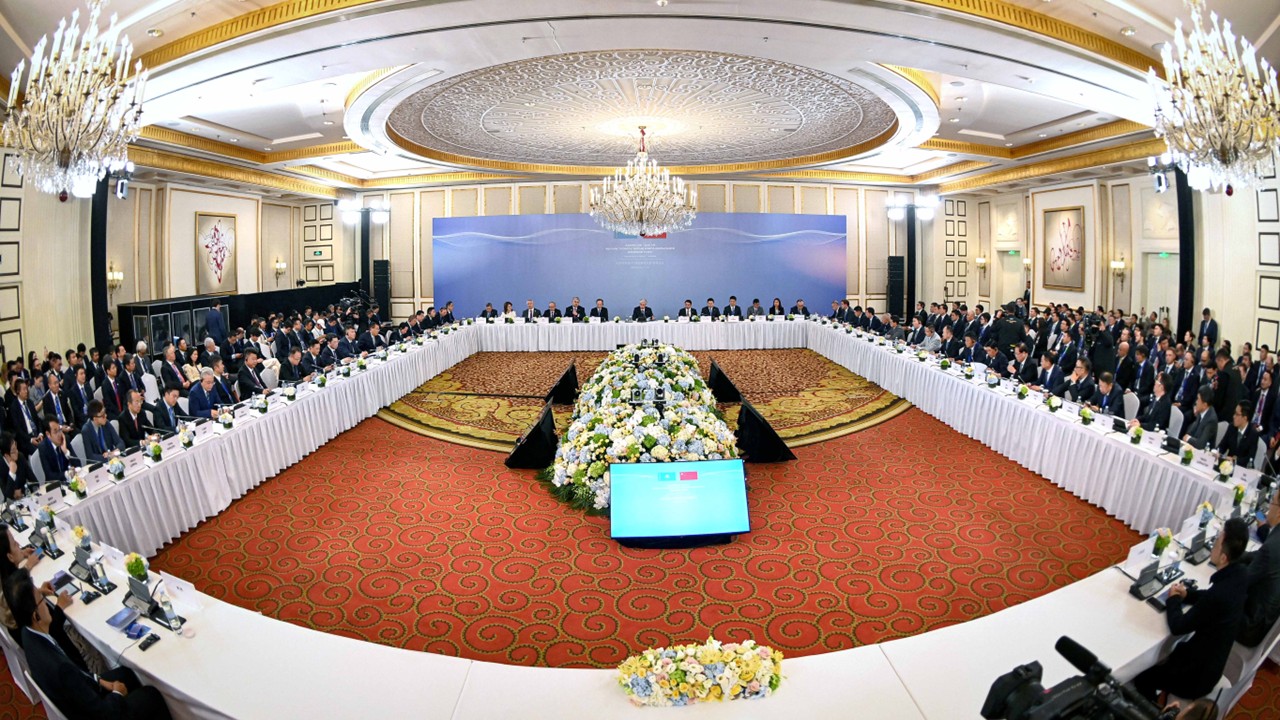
SHANGHAI – President Kassym Jomart Tokayev's series of meetings with senior executives from some of China's largest technology, industrial and logistics companies during his visit to Shanghai may prove to be one of the most significant indicators yet of how regional politics in Asia is evolving.
Rather than focusing solely on government to government agreements, Kazakhstan is increasingly engaging directly with the companies that are driving the world's industrial transformation. The meetings demonstrate how investment decisions made in corporate boardrooms are becoming as influential as traditional diplomacy in determining the future direction of trade, infrastructure and economic cooperation across Eurasia.
During his visit, Tokayev held discussions with executives from battery manufacturer CATL, consumer electronics giant Xiaomi, engineering and infrastructure company China Communications Construction Company (CCCC), and Guoyou Materials Industry Group, among others. Together, these companies represent industries at the forefront of the global economy, spanning electric vehicles, advanced manufacturing, digital technologies, transport infrastructure and integrated logistics.
Individually, each meeting was aimed at attracting investment and strengthening commercial ties. Collectively, however, they reveal a much broader strategy. Kazakhstan is positioning itself not simply as a supplier of raw materials, but as a country capable of supporting the entire industrial value chain, from resource extraction and processing to manufacturing, logistics and international distribution.
The approach reflects the changing nature of geopolitical influence. For decades, the balance of power in Central Asia was largely defined by the relationships between governments and major powers such as Russia, China, Europe and the United States. Today, multinational corporations possess investment capacity, technological expertise and supply chain influence that rival many national economies.
Where these companies choose to establish manufacturing plants, logistics hubs, research centres and distribution networks increasingly determines where jobs are created, infrastructure is built and new industries emerge. Governments are therefore competing not only for diplomatic partnerships but also for corporate investment that can transform national economies.
Kazakhstan appears to have recognised this shift earlier than many countries in the region.
President Tokayev has consistently promoted economic diversification beyond hydrocarbons and mining, while seeking to position Kazakhstan as the principal transport and industrial gateway between Asia and Europe. The country's geographic location gives it a natural advantage, but geography alone is no longer sufficient. Modern trade increasingly depends on digital systems, efficient logistics, integrated supply chains and advanced manufacturing capabilities.
That is why meetings with companies such as CATL and Xiaomi carry significance beyond their immediate commercial value. They represent engagement with industries expected to define global economic growth over the coming decades.
CATL has become one of the world's leading producers of electric vehicle batteries and energy storage technologies, while Xiaomi has expanded beyond smartphones into electric vehicles, smart manufacturing and connected technologies. Their investment decisions increasingly influence where future industrial ecosystems are established.
Equally significant was Tokayev's meeting with Guoyou Materials Industry Group, which proposed constructing a multimodal logistics hub at Kazakhstan's Kuryk Port on the Caspian Sea.
The proposed development would increase the port's handling capacity to 15 million tonnes during its first year while strengthening Kazakhstan's role along the Trans Caspian International Transport Route, more widely known as the Middle Corridor.
The corridor has rapidly become one of the world's most strategically important trade routes. Stretching from western China through Kazakhstan, across the Caspian Sea to Azerbaijan before continuing into Georgia, Türkiye and Europe, it offers an increasingly attractive alternative for freight movement between Asia and European markets.
As manufacturers seek more diversified supply chains and greater resilience against global disruptions, the importance of efficient overland transport routes has continued to grow.
Investment in ports, railways and logistics facilities along the corridor therefore has implications extending well beyond Kazakhstan's borders. It strengthens regional connectivity, supports trade diversification and creates opportunities for neighbouring economies to participate in expanding Eurasian supply chains.
The discussions in Shanghai also highlighted another important dimension of Kazakhstan's economic strategy — the integration of its abundant natural resources with higher value industries.
Kazakhstan possesses some of the world's largest reserves of uranium, copper, chromium, zinc, manganese and other critical minerals essential for electric vehicles, renewable energy systems, semiconductors and advanced manufacturing.
For Chinese companies seeking secure and diversified sources of critical raw materials, Kazakhstan offers an attractive long term partner. At the same time, Kazakhstan is increasingly seeking investments that enable more processing, manufacturing and value addition to occur domestically rather than exporting raw commodities alone.
This creates a complementary relationship in which logistics infrastructure, mineral resources, manufacturing capability and technology investment reinforce one another.
The broader significance of Tokayev's engagements lies in what they suggest about the future of regional politics across Asia.
Economic influence is no longer measured solely by trade agreements or diplomatic summits. Increasingly, it is being shaped by private capital, industrial ecosystems, technology partnerships and the companies that control global supply chains.
Large corporations have become important geopolitical actors in their own right. Their decisions influence employment, education, skills development, technology transfer and infrastructure investment across multiple countries. In many cases, these investments create long term economic relationships that extend well beyond the lifespan of political administrations.
For Kazakhstan, attracting these companies is consistent with its long standing multi vector foreign policy, which seeks to maintain constructive economic relationships with China, Europe, Türkiye, the Gulf states, Japan, South Korea and the United States while avoiding excessive dependence on any single partner.
The meetings in Shanghai demonstrate that this strategy is evolving from one centred largely on diplomacy to one increasingly driven by economic partnerships capable of reshaping industries and regional connectivity.
As Asia enters a period defined by artificial intelligence, clean energy, digital infrastructure and critical minerals, governments that successfully combine strategic geography with investment friendly policies are likely to become increasingly influential.
Kazakhstan is seeking to position itself among that group.
The message emerging from Tokayev's meetings is clear. The future of regional influence will not be determined solely by political leaders around negotiating tables, but also by the companies deciding where to invest, innovate and build the industries that will power the next generation of Asian economic growth.