

Malaysia Becomes a Piece in the Global AI Power Game as US Tightens Export Controls
Washington's latest restrictions on advanced computing technology demonstrate how the US-China rivalry is extending beyond semiconductor manufacturing into data centres, cloud services and remote access. Malaysia's inclusion among countries facing additional licensing requirements offers a clear example of how smaller economies are being drawn into a much larger geopolitical contest.
Malaysia's ambition to become a regional hub for artificial intelligence (AI), cloud computing and data centre investment is increasingly intersecting with one of the world's most consequential geopolitical rivalries.
What was once largely a contest over who could manufacture the most advanced semiconductors has evolved into a broader struggle over who controls access to computing power, where that power is located and, increasingly, who is permitted to use it.
Washington's latest export control measures provide a particularly important illustration of this changing landscape. They also place Malaysia among a group of countries that must now navigate the competing economic and strategic interests of the United States and China.
In an analysis published on November 18, 2026, the Washington-based Center for Strategic and International Studies (CSIS), through its Economics Program and Scholl Chair in International Business, examines the implications of the new US restrictions on remote access to advanced computing technology.
The analysis, titled New Export Controls on Remote Access: The Implications for Industry and Competition with China, is authored by Kate Koren, deputy director of the CSIS Economics Program and Scholl Chair in International Business, and Kevin Kurland, a senior technical expert (non-resident) with the same programme.
Their assessment highlights an important shift in American export control policy: the focus is no longer exclusively on preventing restricted semiconductor hardware from reaching China. It now extends to controlling how computing resources generated by those chips can be accessed remotely, even when the equipment is physically located in another country.
For Malaysia, this is more than an international trade policy development. It has direct implications for the country's ambitions to attract global technology companies and establish itself as a significant player in the digital economy.
On November 16, the US Department of Commerce's Bureau of Industry and Security (BIS) issued an interim final rule introducing additional licensing requirements for advanced computing hardware and remote access to computing resources.
The regulation also formally replaces the Biden administration's earlier AI Diffusion framework, which the Trump administration had announced it would not enforce.
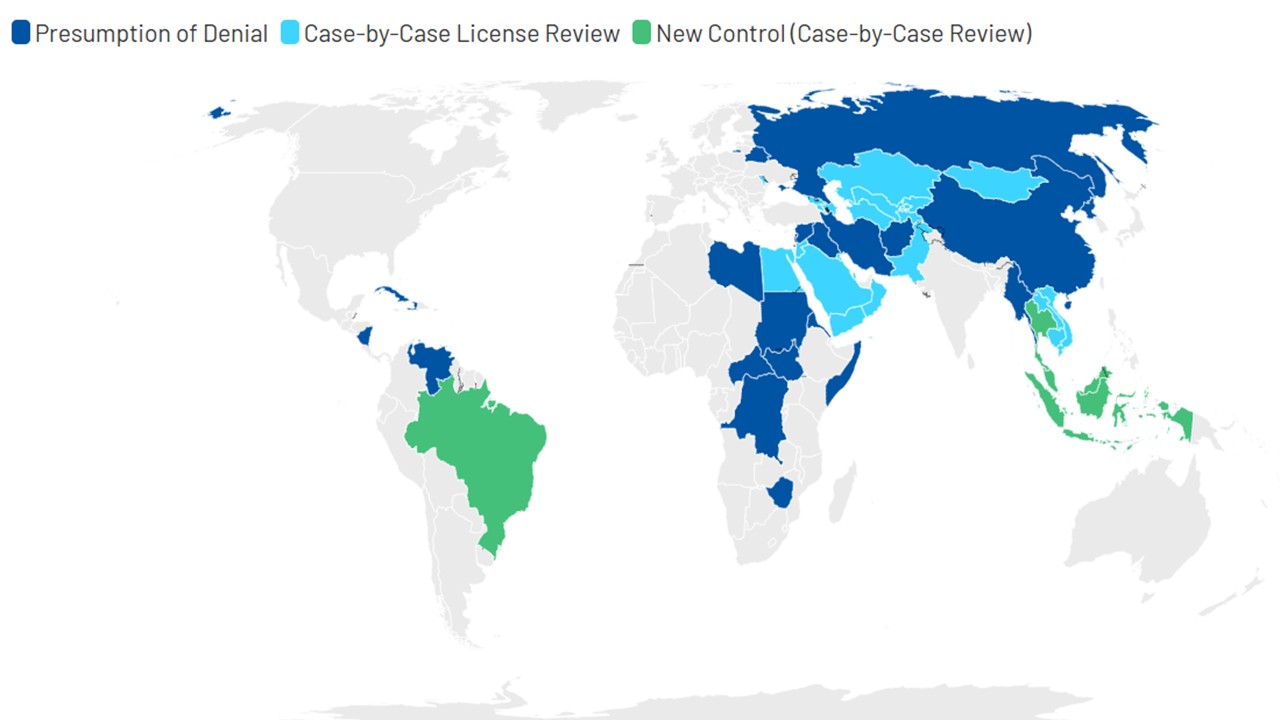
One of the most significant developments is the inclusion of Malaysia, Indonesia, Singapore, Thailand and Brazil among countries subject to additional licensing requirements because of concerns over the diversion of advanced computing technology.
This is not a blanket export ban. Licence applications will be assessed on a case-by-case basis. However, the decision places these countries under greater scrutiny as Washington seeks to prevent advanced American technology from reaching restricted Chinese end users through third-country arrangements.
Malaysia is an especially interesting example because it is simultaneously an important economic partner of China and an increasingly attractive destination for American and international technology investment.
The country has spent considerable effort positioning itself as a regional data centre hub, attracting investments in cloud infrastructure, digital services and the wider technology ecosystem. Its industrial base, geographical position, connectivity and infrastructure have helped make it an attractive destination for international investors.
But the value of a modern data centre is not simply determined by the buildings, land or electricity supply. Its commercial value lies in the computing capacity it provides and the customers who can access that capacity.
This is where the new American rules become particularly consequential.
Previously, the provision of cloud computing services was generally treated differently from the physical export of controlled semiconductor hardware. The new regulation addresses that distinction by introducing controls based on the end use of advanced computing equipment.
Under the new arrangements, exporters must obtain a licence if they know that advanced computing equipment will be used by a data centre anywhere in the world to provide computing resources above specified thresholds to customers headquartered in China or other US arms-embargoed destinations.
CSIS highlights that the threshold of 12 million in aggregate total processing performance is relatively low by large data centre standards. It corresponds approximately to 750 Nvidia H200 GPUs or 42 Vera Rubin systems.
Crucially, the requirements also extend to hardware that has already been exported. Data centres currently providing restricted computing services have 90 days from the regulation's publication to stop those activities or obtain the necessary licences.
This changes the compliance environment for technology companies operating in Malaysia. A company may have legally acquired its hardware, established its infrastructure and secured customers, yet subsequently face restrictions because of the identity or location of those accessing its computing resources.
The consequences extend well beyond compliance departments.
For international investors, uncertainty surrounding export controls can affect procurement, financing, project timelines and the commercial viability of planned facilities. Technology suppliers must undertake more extensive customer due diligence, while data centre operators need greater visibility over the ultimate users of their computing resources.
There is also the possibility of excessive caution, with exporters choosing to restrict legitimate commercial transactions rather than risk violating complicated and evolving regulations.
For Malaysia, the challenge is to ensure that the country remains an attractive destination for international investment without becoming a potential transit point for restricted technology.
This is an important distinction. Malaysia's digital ambitions should not be compromised by its inability to demonstrate that its regulatory framework can manage the risks associated with increasingly sophisticated computing infrastructure.
CSIS also points to the effectiveness of a country's export control regime as an important consideration in licensing decisions. Singapore, for example, is identified as having established strategic goods controls and a track record of enforcement.
This provides a useful comparison for Malaysia. Attracting investment is only one part of becoming a credible regional technology hub. Regulatory capacity, enforcement coordination and the ability to provide certainty to international investors are equally important.
The wider geopolitical implications are difficult to ignore.
China remains a major economic partner for Malaysia and an important participant in global technology supply chains. At the same time, American companies remain central to the supply of advanced computing hardware and many of the technologies underpinning the AI industry.
Malaysia cannot afford to treat either relationship as expendable.
The situation illustrates how countries that are not central participants in the US-China rivalry can nevertheless become important pieces in the global technology game. Their infrastructure, geographical position and commercial relationships can make them strategically relevant to both sides.
The same development also raises questions about the effectiveness of export controls themselves.
Koren and Kurland argue that the restrictions are likely to create additional costs, delays and obstacles for networks seeking to divert advanced computing technology to China, at least in the short term. However, they also caution that procurement networks, particularly those supported by state resources, may seek alternative suppliers and jurisdictions.
In other words, restrictions may slow access without necessarily eliminating demand.
For Southeast Asia, this could mean continuing changes to the regulatory environment as Washington identifies new potential diversion routes and adjusts its enforcement priorities.
Malaysia should therefore avoid viewing the latest measures as an isolated American policy decision. They are part of a much larger transformation in how technology, international trade and national security are increasingly interconnected.
The country needs a coordinated response involving government agencies, industry regulators, technology investors and infrastructure operators. This should include stronger monitoring of advanced computing facilities, clear compliance expectations, improved international cooperation and a regulatory environment that gives legitimate investors confidence.
More importantly, Malaysia must develop its own understanding of what technological sovereignty means.
Being a regional destination for foreign investment is valuable, but long-term competitiveness requires more than hosting infrastructure owned or controlled by international companies. Malaysia must also build domestic capabilities, develop specialised talent and ensure that its digital infrastructure contributes to wider economic development.
The next phase of the AI race will not be determined solely by who manufactures the most advanced chips. It will also be shaped by who controls access to computing power, where that power is located and which governments have the authority to determine how it is used.
Malaysia is now part of that equation.
The question is whether the country can turn its position in the global technology landscape into a strategic advantage, rather than allowing decisions made in Washington and Beijing to define the boundaries of its digital future.
Read the original CSIS analysis: New Export Controls on Remote Access: The Implications for Industry and Competition with China, by Kate Koren and Kevin Kurland, November 18, 2026.