

UN Global Compact backs Climate Finance Innovation Lab to accelerate Malaysia's green investment pipeline
The UN Global Compact Network Malaysia, Brunei & Cambodia has joined the Climate Finance Innovation Lab Accelerator Programme as a strategic partner, strengthening efforts to turn climate and nature projects into investment ready opportunities that can attract private and public capital.
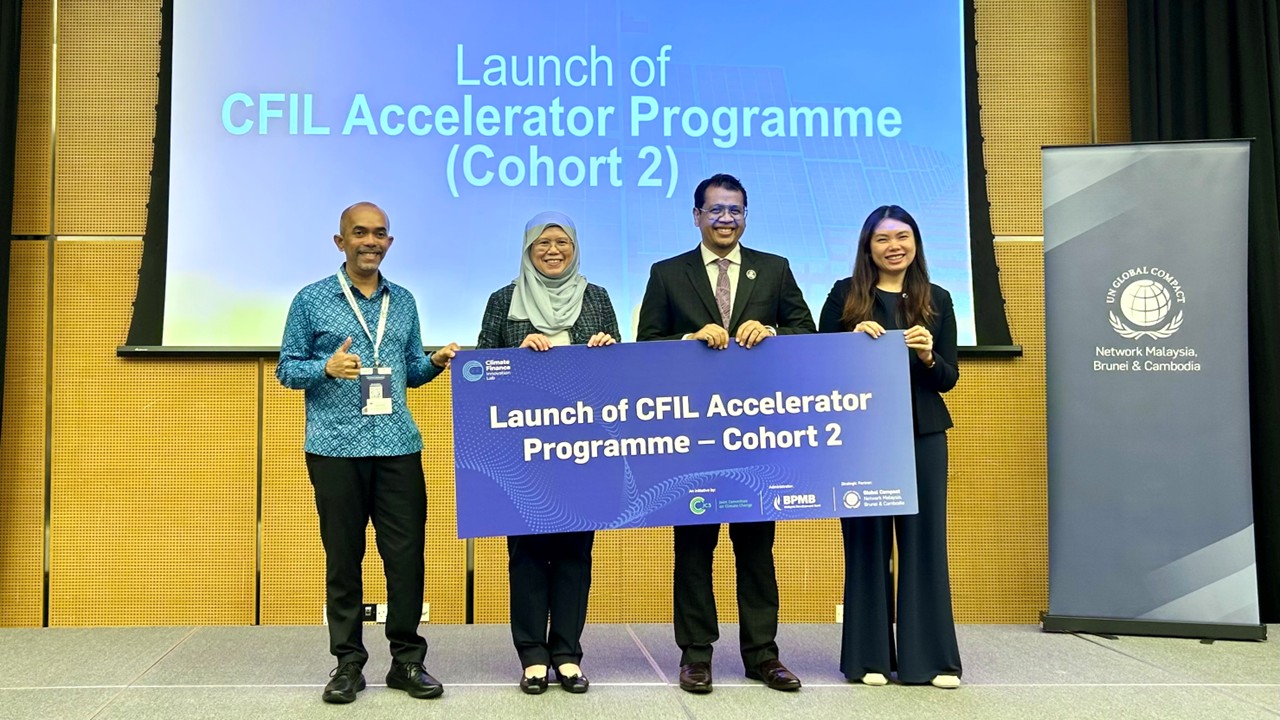
KUALA LUMPUR – Malaysia is taking another step towards unlocking climate finance with the UN Global Compact Network Malaysia, Brunei & Cambodia (UNGCMBC) joining the second Climate Finance Innovation Lab (CFIL) Accelerator Programme as a strategic partner to help develop investment ready climate and nature solutions.
The announcement was made during the Climate Finance Innovation Lab Showcase, held as a side event of Sasana Symposium 2026, where the second cohort of the accelerator programme was launched. The event brought together climate innovators, financiers, policymakers and ecosystem partners to showcase projects aimed at supporting Malaysia's transition to a low carbon, climate resilient economy.
The Climate Finance Innovation Lab is an initiative of the Joint Committee on Climate Change (JC3), administered by Bank Pembangunan Malaysia Berhad (BPMB). It was established to develop innovative climate finance mechanisms capable of mobilising both public and private investment to support Malaysia's net zero ambitions, strengthen climate resilience and advance nature positive development.
As strategic partner, UNGCMBC will play a central role in designing and delivering the accelerator programme, coordinating learning modules, participant engagement, programme administration and supporting the recruitment of coaches and subject matter experts. The programme is designed to strengthen projects' investment readiness by refining business models, improving ESG and climate impact propositions and identifying clearer pathways to capital.
Participants will undergo an intensive development programme comprising virtual sessions, physical boot camps, one to one mentoring and an AI powered advisory tool that helps identify gaps in project development before presenting their proposals to investors during the JC3 Conference in September.
Speaking at the launch, Faroze Nadar, Executive Director of UN Global Compact Network Malaysia, Brunei & Cambodia, said Malaysia's climate transition requires more than additional funding.
"Malaysia's transition will require not only greater flows of climate finance, but stronger collaboration to ensure capital reaches credible, high impact solutions. Through CFIL, there is an opportunity to strengthen the pipeline of climate and nature positive projects that can deliver both financial value and measurable impact.
"UNGCMBC is pleased to support the Accelerator Programme as Strategic Partner, helping innovators move from ambition to investment readiness and scalable implementation."
The accelerator will focus on projects across four strategic sectors: energy transition and green innovation, circular economy and sustainable cities, sustainable agriculture, and biodiversity and nature based solutions. Through structured coaching and expert guidance, participants will refine their value propositions, assess financial viability and develop measurable impact outcomes before engaging potential funders and strategic partners.
The programme reflects Malaysia's growing emphasis on blended finance and public private collaboration as the country seeks to mobilise significantly greater investment to meet its climate commitments. Financial institutions, government agencies and sustainability organisations have increasingly recognised that while many innovative climate projects exist, one of the largest barriers remains preparing them to meet investor expectations.
UNGCMBC said its involvement highlights the importance of multi stakeholder collaboration in closing financing gaps and supporting Malaysia's broader sustainability agenda. As the Malaysia, Brunei and Cambodia network of the United Nations Global Compact, the organisation works with businesses to advance the UN Sustainable Development Goals and translate sustainability commitments into practical action through education, partnerships and capacity building.
The Climate Finance Innovation Lab will culminate in a Demo Day during the JC3 Conference in September, where participating projects will present directly to financiers, policymakers and ecosystem partners, providing a pathway from innovation to commercial deployment.
The Climate Finance Innovation Lab (CFIL) is an initiative by the Joint Committee on Climate Change. It serves as a collaborative platform to ideate, develop and accelerate innovative climate finance solutions and mechanisms that can mobilise private and public finance to support Malaysia’s transition to net zero, strengthen climate resilience and advance nature-positive actions.