

Russia and Laos Seek to Deepen Strategic Partnership as Lavrov Meets New Prime Minister
Russian Foreign Minister Sergey Lavrov meets Lao Prime Minister Saleumxay Kommasith on the sidelines of the 21st East Asia Summit in Manila on Nov 17, 2026. Photo: Russian Foreign Ministry.
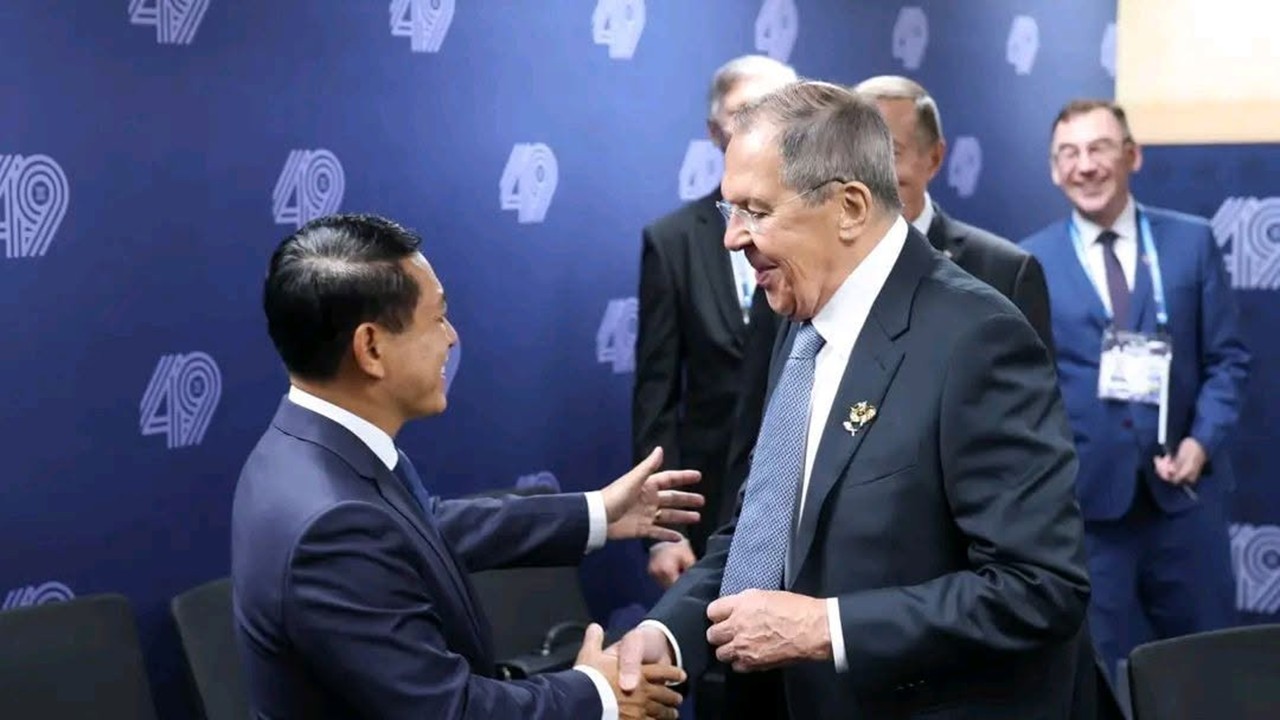
MANILA - Russia is seeking to strengthen its economic and strategic engagement with Laos, with trade, investment, energy and information technology among the priorities discussed during talks between Russian Foreign Minister Sergey Lavrov and newly appointed Lao Prime Minister Saleumxay Kommasith in Manila.
The meeting on Nov 17 took place on the sidelines of the 21st East Asia Summit (EAS), providing an opportunity for Moscow to reinforce its relationship with one of Southeast Asia's longstanding partners.
According to Russia's Foreign Ministry, the discussions focused on advancing political dialogue and practical cooperation, particularly in trade and investment, humanitarian affairs, fuel and energy, and information and communications technology.
The two sides also discussed cooperation through multilateral platforms, including the East Asia Summit, the Shanghai Cooperation Organisation (SCO), the Conference on Interaction and Confidence-Building Measures in Asia (CICA) and the Russia-ASEAN Dialogue Partnership.
The meeting was particularly significant as it was Lavrov's first engagement with Saleumxay following his appointment as Laos' prime minister in October 2026, succeeding Sonexay Siphandone.
The talks follow a series of high-level exchanges between Moscow and Vientiane in 2026. Lao President Thongloun Sisoulith visited Moscow in May, while former prime minister Sonexay Siphandone attended the Russia-ASEAN Summit in Kazan in June, where he also met Russian President Vladimir Putin.
Lavrov referred to both engagements during his meeting with Saleumxay, signalling Moscow's intention to maintain continuity in its relationship with the new Lao administration.
A strategic relationship with economic and geopolitical dimensions
Laos has traditionally maintained close political and diplomatic relations with Russia, dating back to the Soviet era. Cooperation has included education, technical training, defence and economic development.
For Moscow, closer ties with Laos also provide an avenue to maintain its diplomatic and economic presence in Southeast Asia, where ASEAN remains an important regional platform.
For landlocked Laos, which is seeking to strengthen its position as a regional transport and energy hub, cooperation in infrastructure, energy and technology offers potential areas for economic engagement.
Energy is particularly relevant. Laos has invested heavily in hydropower development and electricity exports to neighbouring countries, positioning itself as a regional power supplier. Cooperation with Russia in the fuel and energy sector could complement these ambitions, although the latest meeting did not announce specific projects or financial commitments.
The wider diplomatic context is also important. Russia has been seeking to strengthen engagement with Asian partners as its relations with Western countries remain strained following the invasion of Ukraine in 2022.
The East Asia Summit, established in 2005, brings together ASEAN's 11 member states and eight dialogue partners, including Russia, China, the United States, India, Japan, South Korea, Australia and New Zealand. It provides a platform for discussions on regional security, economic cooperation, energy and connectivity.
The reference to the SCO and CICA also reflects Laos' interest in engaging with wider Eurasian cooperation frameworks. The SCO focuses on regional security and economic cooperation, while CICA provides a multilateral platform for confidence-building and security dialogue across Asia.
While no new agreements were announced following the Lavrov-Saleumxay meeting, the discussions underline Russia's intention to preserve and expand its longstanding relationship with Laos at a time of shifting geopolitical and economic alignments across the Indo-Pacific.