

Philippines Puts South China Sea Arbitration at Centre of ASEAN Security
Manila is seeking to turn the 2016 South China Sea arbitral award into a broader regional security principle as ASEAN prepares for a change of leadership from the Philippines to Singapore. A meeting between Philippine Defence Secretary Gilberto Teodoro Jr. and Singapore Defence Minister Chan Chun Sing highlights the bloc's challenge: defending international law and freedom from coercion while maintaining unity among members with differing strategic interests.
The Philippines is seeking to reinforce the role of international law in Southeast Asian security as it prepares to hand the ASEAN chairmanship to Singapore, with maritime coercion, foreign interference and regional instability increasingly shaping the security agenda.
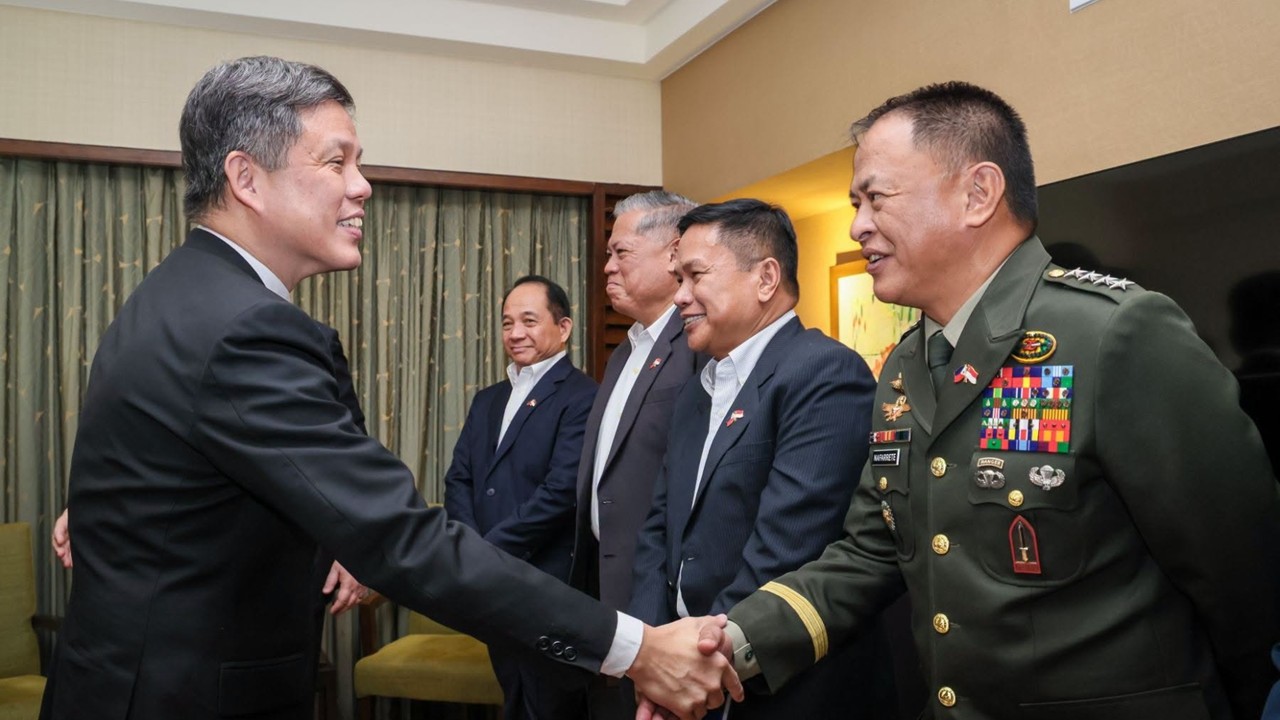
At a meeting in Lapu-Lapu City on October 27, Philippine Secretary of National Defense Gilberto C. Teodoro Jr. discussed regional defence challenges with Singapore Defence Minister Chan Chun Sing on the sidelines of the 20th ASEAN Defence Ministers' Meeting (ADMM) and the 13th ADMM-Plus. Teodoro championed the 2016 arbitral award on the South China Sea, arguing that its underlying principles could benefit ASEAN member states beyond the immediate dispute between Manila and Beijing.
The two ministers also discussed what the Philippine defence department described as malign foreign interference and coercion at sea, as well as opportunities to strengthen defence partnerships, develop military capabilities and improve supply-chain resilience. With Singapore preparing to take over the ASEAN and ADMM chairmanship from the Philippines on October 29, the meeting also addressed the future of the ASEAN Observer Team mission supporting coordination and stability along the Cambodia-Thailand border.
Although presented as a bilateral defence discussion, the meeting reflects a wider question confronting Southeast Asia: how can ASEAN protect regional stability and uphold international law when its members have different threat perceptions, economic dependencies and relationships with major powers?
The 2016 award and the regional stakes
The arbitral award issued on July 12, 2016, under the United Nations Convention on the Law of the Sea (UNCLOS) remains a central reference point in the Philippines' maritime policy.
The tribunal, constituted under Annex VII of UNCLOS, rejected the legal basis for China's claims to historic rights to resources within the so-called nine-dash line to the extent that they exceeded the maritime entitlements permitted under the convention. It also examined the status of maritime features and the legality of specific Chinese actions in the South China Sea.
The tribunal did not rule on sovereignty over land territory, nor did it delimit a maritime boundary between China and the Philippines. Beijing rejected the proceedings and continues to reject the award, maintaining that the tribunal lacked jurisdiction and that its conclusions are invalid.
For Manila, however, the award provides a legal foundation for challenging maritime claims and conduct that it considers inconsistent with international law. The Philippine government has consistently argued that the decision is final and binding on the parties under UNCLOS.
Teodoro's emphasis on the award's fundamental principles is significant because the Philippines is presenting the dispute as more than a bilateral contest over reefs, fishing grounds and maritime features. Its broader argument is that the rules governing maritime entitlements, navigation and the peaceful settlement of disputes matter to all coastal states, including those without direct territorial claims in the South China Sea.
For ASEAN, this presents both an opportunity and a challenge. International law offers a common framework for managing maritime disputes, but member states differ in their willingness to criticise China or place the arbitral award at the centre of regional diplomacy.
The question is whether ASEAN can translate shared commitments to UNCLOS and peaceful dispute settlement into a more consistent regional position without deepening internal divisions.
Maritime coercion and the limits of regional diplomacy
The Philippine defence department said Teodoro and Chan discussed regional security challenges, particularly foreign interference and coercion at sea as experienced by the Philippines.
The wording reflects Manila's concern that maritime pressure can extend beyond conventional military confrontation. Coast guard deployments, maritime militia activity, dangerous manoeuvres, obstruction of resupply missions and other forms of pressure can affect a state's ability to exercise its rights without crossing the threshold of armed conflict.
Such activities present a difficult problem for regional security institutions. They can create sustained pressure on a claimant state while leaving other governments divided over how to respond.
The Philippines has sought to strengthen its defence partnerships and make its maritime experiences more visible internationally. Cooperation with countries that support a rules-based maritime order can help Manila improve surveillance, operational readiness, maritime domain awareness and its ability to document incidents.
But the challenge is not exclusively military. A credible regional response also depends on diplomatic coordination, information-sharing, crisis communication and the ability to prevent incidents at sea from escalating.
Singapore's position is particularly relevant. As a major trading and maritime centre, it has a strong interest in the stability of international shipping routes and the continued application of international law. At the same time, its diplomatic approach emphasises regional stability and engagement with a broad range of partners.
The meeting between Teodoro and Chan therefore offers an opportunity to explore areas of practical cooperation without assuming that the two countries must adopt identical positions on every aspect of regional diplomacy.
Singapore's chairmanship: An opportunity to strengthen ASEAN
Singapore's assumption of the ASEAN and ADMM chairmanship on October 29 places it at the centre of the bloc's next phase of defence diplomacy.
The chairmanship carries responsibilities beyond convening meetings. It requires managing competing national interests, maintaining communication among defence establishments and finding areas of agreement that can produce practical results.
For Singapore, a central task will be to sustain regional cooperation while ASEAN members navigate intensifying competition among major powers. Maritime security, cyber threats, disinformation, foreign interference and supply-chain vulnerabilities are likely to remain important concerns.
The South China Sea will continue to test ASEAN's ability to balance international law, regional unity and relations with China. While the 2016 award is particularly important to the Philippines, other members may be reluctant to frame regional discussions around the decision because of their own economic and diplomatic calculations.
A pragmatic approach could focus on principles that have broader regional support: adherence to international law, respect for sovereign rights and jurisdiction under UNCLOS, freedom of navigation and overflight as applicable under international law, peaceful dispute settlement and the prevention of dangerous encounters at sea.
These principles would not eliminate differences over specific claims, but they could provide a basis for more consistent regional conduct.
Singapore's chairmanship will also be judged by its ability to maintain momentum on practical defence cooperation. Joint exercises, humanitarian assistance and disaster relief, maritime information-sharing and military-to-military communication can help reduce the risk of miscalculation even when political disagreements remain unresolved.
The challenge will be to make progress without allowing consensus-based diplomacy to become an excuse for avoiding difficult security questions.
Defence partnerships and supply-chain resilience
Teodoro also highlighted the Philippines' defence relationships with Japan, Canada, South Korea, Australia, India and New Zealand, pointing to opportunities for expanded practical cooperation, capability development and supply-chain resilience.
This reflects a broader shift in the Philippines' security strategy towards a wider network of defence partnerships. Rather than relying on a single relationship, Manila is seeking to strengthen its ability to train, equip and sustain its armed forces through cooperation with multiple partners.
The countries named by Teodoro offer different strengths. Japan has expanded its security engagement and support for regional partners. Australia and South Korea have established defence-industrial and military cooperation with Southeast Asian states. India has increased its strategic engagement with the wider Indo-Pacific, while Canada and New Zealand contribute to regional security dialogue and practical cooperation.
For the Philippines, a wider network can improve access to training, equipment, maintenance, surveillance technology and other capabilities. It can also reduce the risks associated with dependence on a limited number of suppliers.
Supply-chain resilience is increasingly important because modern military readiness depends on access to spare parts, ammunition, maintenance services, communications equipment and specialised technologies. Disruptions to these supply chains can undermine operational effectiveness even when forces possess modern platforms.
Diversification, however, is not straightforward. Different equipment systems may be incompatible, while procurement from multiple countries can increase maintenance costs, training requirements and logistical complexity. Building a more resilient defence-industrial base therefore requires careful planning rather than simply increasing the number of suppliers.
For ASEAN, these developments also raise a wider question about how regional defence cooperation can complement national modernisation without accelerating an arms competition.
The objective should be to strengthen deterrence and preparedness while preserving communication channels and confidence-building measures that reduce the risk of conflict.
Cambodia and Thailand: A separate test of ASEAN's credibility
The meeting between Teodoro and Chan also addressed the future of the ASEAN Observer Team mission supporting coordination and stability along the Cambodia-Thailand border.
This issue illustrates another dimension of ASEAN's security role. While maritime disputes attract considerable attention because of their connection to major-power competition, tensions between member states can pose a direct challenge to the bloc's commitment to peaceful dispute management.
An observer mission can help maintain communication, monitor developments within its mandate and support confidence-building between parties. Its effectiveness, however, depends on the consent and cooperation of the countries concerned, clarity about its responsibilities and continuity of engagement.
The incoming Singapore chairmanship will inherit the task of helping sustain regional coordination as ASEAN seeks to prevent border tensions from undermining wider political and economic cooperation.
The Cambodia-Thailand situation differs fundamentally from the South China Sea dispute. It involves a different set of historical, territorial and bilateral dynamics, and the appropriate mechanisms for managing it cannot simply be transferred from one dispute to another.
Nevertheless, the two issues share a common regional principle: disagreements should be managed through peaceful processes, reliable communication and respect for applicable international obligations.
ASEAN's credibility depends partly on whether its members can demonstrate that commitment in practice, including when disputes occur between members rather than between a member and an external power.
The wider Indo-Pacific calculation
The Philippines' growing defence engagement with partners across the Indo-Pacific reflects concern about the strategic environment surrounding the South China Sea. It also reflects the reality that maritime security cannot be managed by individual countries acting alone.
Shipping routes, undersea infrastructure, energy supplies, digital networks and defence supply chains connect economies across the region. A serious disruption in one area can affect trade and security well beyond the immediate location of a confrontation.
For Japan, Australia, India and other partners, cooperation with Southeast Asian states provides a means of strengthening regional resilience and maintaining a stable maritime environment. For the Philippines, these partnerships offer additional capabilities and diplomatic support as it seeks to defend its maritime interests.
Singapore's role is different but complementary. Its strategic importance derives in part from its position as a major maritime, logistics and financial centre, as well as its longstanding emphasis on regional engagement and a stable international order.
The challenge for ASEAN is to ensure that wider defence partnerships reinforce regional stability rather than divide the bloc into competing camps.
That will require ASEAN members to retain their ability to cooperate across different partnerships, maintain dialogue with China and other major powers, and avoid treating every regional security issue as a choice between rival strategic alignments.
It will also require greater attention to practical resilience: protecting critical infrastructure, strengthening maritime awareness, improving crisis communication and reducing vulnerabilities in defence and commercial supply chains.
From declarations to practical security
The meeting in Lapu-Lapu City demonstrates how bilateral defence diplomacy can support a wider regional agenda. Teodoro's appeal to the 2016 arbitral award places international law at the centre of the Philippines' approach, while his emphasis on defence partnerships highlights Manila's effort to build the capabilities needed to protect its interests.
Chan's discussions with Teodoro also come at an important moment for Singapore, which is preparing to assume responsibility for steering ASEAN and ADMM discussions through a difficult regional environment.
But the success of the transition will not be measured simply by statements issued at meetings. It will depend on whether ASEAN can sustain meaningful cooperation on maritime security, improve its capacity to manage crises and preserve the principle that disputes should be resolved peacefully under international law.
For the Philippines, the immediate objective is to ensure that the 2016 award remains relevant to regional discussions and that its defence partnerships produce tangible improvements in capability and resilience. For Singapore, the task is to maintain ASEAN's ability to act collectively while recognising the different interests of its members.
The larger test is whether Southeast Asia can strengthen its security without sacrificing the diplomatic relationships and economic connections on which its prosperity depends.
The 2016 arbitral award remains a legal reference point in the South China Sea dispute, but its wider significance will depend on how consistently regional states uphold the principles of international law. As Singapore takes over the ASEAN chairmanship, the challenge is to turn those principles into practical cooperation that protects regional stability, reduces the risk of coercion and gives smaller states greater confidence in the rules governing their shared maritime environment.