


Why the Bay of Bengal Is Becoming a Strategic Battleground?
Tokyo’s plan to mobilise up to one trillion yen in private investment in Bangladesh over five years is about more than jobs and industrial development. Through its expanded BIG-B initiative, Japan is seeking to build resilient supply chains, secure maritime interests and strengthen its position in an increasingly contested Indo-Pacific. For Bangladesh, the opportunity is substantial, but converting diplomatic commitments into sustainable economic transformation will require difficult domestic reforms.
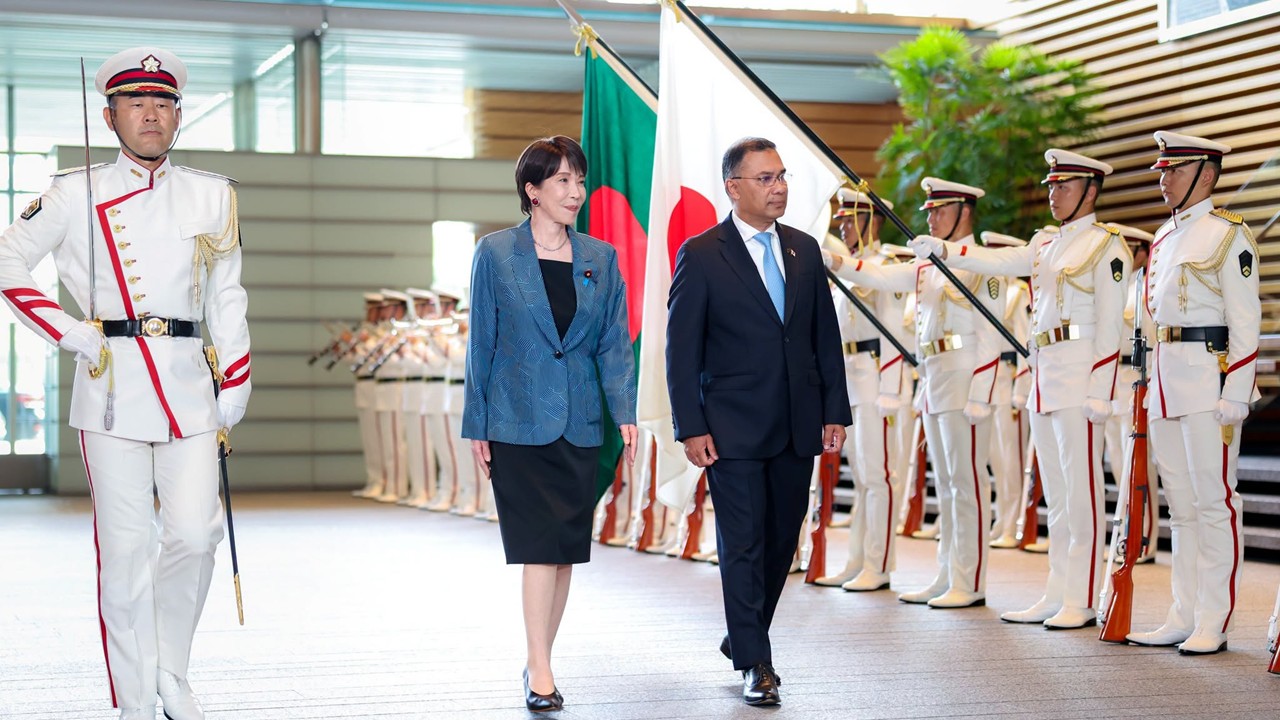
Japan’s offer to help mobilise up to one trillion yen (approximately US$6.3 billion) in private investment in Bangladesh over the next five years could become one of the most consequential economic initiatives in the relationship between the two countries. Yet the significance of the announcement by Japanese Prime Minister Sanae Takaichi and her Bangladeshi counterpart, Tarique Rahman, extends well beyond its financial value.
At their summit in Tokyo on October 27, the two leaders agreed to transform the Bay of Bengal Industrial Growth Belt, known as BIG-B, into a broader strategic cooperation framework called BIG-B for Shared Prosperity. The initiative links industrial development and infrastructure with energy security, supply-chain resilience, disaster preparedness and regional stability. Japan also projected that the anticipated private investment could generate approximately 200,000 jobs in Bangladesh. The leaders reaffirmed their commitment to the early entry into force of the Japan-Bangladesh Economic Partnership Agreement, signed in February, and announced additional cooperation in areas ranging from agriculture and fisheries to climate change and maritime security.
Taken together, the announcements point to a change in the character of the bilateral relationship. Japan is not simply offering another package of development assistance. It is seeking to connect Bangladesh more deeply to Japanese investment, regional production networks and the economic architecture of the Indo-Pacific. For Dhaka, the challenge is to turn that interest into productive capacity, higher-value exports and employment. For Tokyo, the challenge is to demonstrate that a development-centred partnership can remain commercially viable while helping strengthen the resilience of a strategically important maritime region.
The Bay of Bengal moves to the centre
The Bay of Bengal occupies an important position between South Asia and Southeast Asia, connecting the Indian Ocean with major Asian manufacturing centres and international shipping routes. Its importance is not merely geographical. The surrounding economies are expanding, regional infrastructure is developing, and governments are increasingly concerned about the security of maritime transport, access to energy and the concentration of manufacturing in a limited number of countries.
For Japan, whose economy depends heavily on international trade and imported energy, reliable sea routes and diversified supply chains are essential national interests. Bangladesh offers an opportunity to pursue these objectives through investment in ports, transport, power generation, industrial facilities and digital infrastructure. Its position between India and Myanmar, with access to the Bay of Bengal, gives it potential to serve as a production and logistics base connecting South and Southeast Asian markets.
That potential, however, should not be confused with an established regional hub. Bangladesh must still address infrastructure bottlenecks, energy constraints, regulatory uncertainty and the cost of moving goods efficiently from factories to international markets. BIG-B for Shared Prosperity is significant because it attempts to address these challenges as interconnected problems rather than treating each infrastructure project as an isolated undertaking.
The framework's four pillars are stronger connectivity; preparedness for natural disasters and geopolitical risks; public-private partnerships to create economic opportunities and develop rules; and cooperation for peace and stability. This is a broader ambition than simply building roads, ports or industrial estates. It envisages an economic ecosystem in which infrastructure, investment, manufacturing and trade reinforce one another. The central test will be whether the initiative can attract enough commercially sustainable activity to justify its scale.
Matarbari: The infrastructure bet behind the strategy
The Matarbari-Maheshkhali area in southeastern Bangladesh is emerging as a focal point for the initiative, with the Matarbari Deep-Sea Port expected to play a central role. The vision is to integrate port facilities with industrial zones, power and energy infrastructure, and transport networks. The two governments have also expressed their intention to discuss future cooperation on the port's operation and management.
A deep-sea port can potentially accommodate larger vessels and improve access to international shipping networks. Integrated with industrial facilities, it could help reduce logistical friction, attract manufacturers and support the development of export-oriented production. But a port does not automatically create an industrial hub. Its commercial success will depend on cargo volumes, shipping connections, competitive port charges, reliable electricity, efficient customs procedures and the ability of businesses to move goods between production centres and international markets.
Industrial investors will also need confidence that the infrastructure will be completed on time and that supporting services will be available when their factories begin operating. This is where the broader BIG-B approach could make a difference. By linking port development with energy supply, industrial investment, airport capacity and urban transport, Japan and Bangladesh are attempting to create the conditions for businesses to operate at scale.
The two leaders also agreed to advance preparations for the early operationalisation of the third terminal at Hazrat Shahjalal International Airport in Dhaka and expressed their intention to move forward with the early construction of Dhaka's mass rapid transit lines. These projects serve different purposes, but together they reflect a recognition that international competitiveness depends on more than export factories. It requires the movement of goods, workers, executives, technical specialists and information through a reliable national infrastructure network.
The investment question is whether private companies will commit capital in sufficient numbers to make these connected assets economically productive.
One trillion yen: An investment projection, not a blank cheque
The headline figure of one trillion yen, equivalent to approximately US$6.3 billion, gives the partnership considerable visibility. The projected creation of 200,000 jobs also offers Bangladesh a potentially important economic dividend. However, the distinction between an investment projection and a fully committed programme is essential.
The announcement concerns anticipated private investment by Japanese businesses over five years. It should not be interpreted as a single government grant, a guaranteed public expenditure package or money already disbursed. Actual investment will depend on individual companies' commercial decisions, project financing, market demand and confidence in Bangladesh's operating environment.
The governments have identified manufacturing, food and agriculture, information and communications technology, and pharmaceuticals as areas for developing more resilient supply chains. Other cooperation priorities include trade, investment, aviation, environmental protection and climate change. These sectors offer different opportunities. Manufacturing could support industrial diversification and deepen Bangladesh's integration into international production networks. Agriculture and food-related industries could benefit from better processing, storage, logistics and access to markets. ICT investment could help develop digital services and technical skills, while pharmaceuticals could provide opportunities for higher-value industrial activity.
The wider objective should be to move beyond investment measured only by the amount of capital entering the country. Bangladesh would benefit more if Japanese investment generated domestic supplier networks, technology transfer, management expertise, workforce training and opportunities for local businesses to participate in higher-value production. Without these links, foreign investment can create jobs and increase exports without necessarily generating the broader industrial transformation the initiative promises. The quality of investment will therefore matter as much as its quantity.
The trade agreement must now deliver
A central component of the relationship is the Japan-Bangladesh Economic Partnership Agreement, signed on February 6, 2026. The agreement is Bangladesh's first economic partnership agreement of this kind with Japan. It is designed to improve market access and establish rules governing trade, investment, services, intellectual property, customs procedures and trade facilitation. The two leaders reaffirmed their commitment to bringing the agreement into force at an early date.
Its importance extends beyond the immediate reduction of tariffs. A predictable framework for commercial activity can make it easier for companies to plan production, establish supplier relationships and commit capital over longer periods. For Bangladesh, the agreement is particularly relevant as the country prepares for its graduation from least developed country status, which is expected to affect the terms under which some of its exports access overseas markets. The agreement could help support that transition by providing a more structured basis for trade with Japan.
But formal market access does not guarantee export growth. Businesses must still meet product standards, maintain consistent quality, deliver on time and compete with suppliers from other countries. Bangladesh will also need to ensure that its domestic companies understand how to use the agreement, including its rules of origin and other requirements governing preferential treatment.
For Japanese investors, the commercial appeal will depend on whether Bangladesh can provide a sufficiently predictable environment for establishing and operating businesses. At the summit, Takaichi emphasised the need to improve conditions for Japanese companies, while Rahman pledged to work towards a more transparent and business-friendly environment. The governments have also signed a memorandum of cooperation covering economic relations and improvements to the business environment.
The practical issues are familiar but consequential: taxation, customs clearance, licensing, remittances, administrative procedures and the consistency of regulatory decisions. These are not secondary matters. They can determine whether a company chooses to establish a manufacturing facility in Bangladesh or invest elsewhere.
Japan's answer to a more uncertain Indo-Pacific
The economic agenda cannot be separated from the geopolitical language used at the summit. Takaichi said Japan would support Bangladesh's ability to make its own decisions and strengthen its resilience under Japan's updated Free and Open Indo-Pacific vision. She also emphasised the two countries' strategic partnership and their shared interest in regional peace and prosperity.
This language reflects a broader Japanese approach to regional engagement: strengthening economic links and infrastructure while supporting a regional order in which countries retain the ability to make independent decisions. The Bay of Bengal matters in this context because economic dependence, maritime access and strategic influence increasingly overlap.
China has established a substantial economic presence across South Asia through trade, infrastructure development and investment. India, meanwhile, has enduring strategic and economic interests in its neighbourhood and the northern Indian Ocean. Japan is not entering an empty strategic space. Its approach must account for the interests of these regional powers as well as the priorities of Bangladesh itself.
The new BIG-B framework offers Tokyo a way to strengthen its presence through commercially oriented cooperation rather than presenting the relationship primarily in military terms. Ports, energy systems, industrial zones and supply chains can influence a country's long-term economic relationships. Once businesses establish production facilities and supplier networks, those relationships can persist for decades. The same infrastructure can also strengthen a country's economic resilience by expanding its options for trade, investment and international cooperation.
For Bangladesh, the opportunity is to attract investment from multiple partners while retaining control over its development priorities. The country does not need to frame its economic future as a choice between Japan, China, India or other external partners. Instead, it can seek competitive financing, technology and market access from different sources, provided the projects serve national interests and remain financially sustainable.
Japan's emphasis on Bangladesh's freedom to make its own decisions is therefore significant. It presents the partnership as an effort to strengthen the country's capacity and choices rather than simply expand Japanese influence. The credibility of that approach will ultimately be measured by the terms of the projects, their economic returns and the extent to which Bangladesh retains meaningful ownership of its development strategy.
Maritime security moves closer to the economic agenda
One of the summit's most important announcements was Japan's decision to provide Bangladesh with a patrol vessel through security-related official development assistance. The leaders also reaffirmed their intention to continue security and defence cooperation. The decision links maritime security to the broader economic partnership. Ports and shipping routes are more valuable when businesses can rely on safe and predictable maritime activity.
For Bangladesh, stronger maritime capabilities could support the protection of its waters and help it respond to maritime security challenges. For Japan, cooperation with a country positioned on the Bay of Bengal strengthens its engagement with a region that is important to international shipping. The announcement is consistent with a wider trend in which Japan has placed greater emphasis on helping partner countries develop capabilities that contribute to regional security.
However, the provision of a patrol vessel should not be overstated as a military alliance or a fundamental realignment of Bangladesh's foreign policy. The summit's language remained centred on cooperation, regional stability and maritime security. Its significance lies in the way security cooperation is being incorporated into a relationship previously identified more strongly with economic development and infrastructure. This could create a more durable partnership by connecting commercial interests with a shared concern for regional stability.
Energy security and the cost of industrial growth
No industrial strategy can succeed without reliable and competitively priced energy. Bangladesh's ability to attract manufacturing investment will depend partly on whether it can reduce the uncertainty associated with energy supply and cost. The summit addressed this issue through wider cooperation on energy infrastructure and economic resilience. The two governments also highlighted the importance of climate change cooperation, energy efficiency and renewable energy.
A separate energy-resilience loan announced in connection with the visit provides another indication of how economic security is becoming part of the relationship. Japan's approach combines infrastructure development with efforts to strengthen the systems on which industrial activity depends. For Bangladesh, this creates an opportunity to link new industrial capacity with more efficient energy use and a gradual expansion of cleaner energy sources.
But the balance will be difficult. Rapid industrialisation can increase electricity demand, while investment in new energy infrastructure requires capital, time and careful planning. The country must also manage exposure to fluctuations in global fuel prices and the risks associated with dependence on imported energy. The long-term objective should not simply be to provide enough power for new factories. It should be to create an energy system that remains affordable, reliable and resilient as industrial demand grows.
If Bangladesh succeeds, it could strengthen its appeal to Japanese manufacturers while reducing some of the vulnerabilities that constrain domestic businesses. If it fails, energy bottlenecks could undermine the investment ambitions announced in Tokyo.
Climate resilience is part of the economic equation
The decision to place preparedness for natural disasters and geopolitical risks among the four pillars of BIG-B reflects the particular vulnerabilities of the Bay of Bengal region. Bangladesh faces recurring exposure to cyclones, flooding and other climate-related hazards. These risks affect communities, transport networks, agriculture, industrial facilities and coastal infrastructure.
For investors, resilience is a commercial consideration. Disruptions to ports, electricity systems or transport links can increase operating costs and interrupt production. A modern industrial hub therefore needs more than efficient logistics and competitive labour costs. It also needs infrastructure designed to withstand foreseeable hazards and systems capable of restoring operations after a disruption.
The summit's cooperation on environmental protection, agriculture, fisheries and livestock could support a broader approach to resilience. Such cooperation could create opportunities for better agricultural practices, more efficient resource use and stronger environmental management, while helping businesses adapt to climate-related risks. The challenge will be to ensure that environmental considerations are integrated into project planning from the beginning rather than treated as an additional requirement after infrastructure has been designed.
For Japan, which has extensive experience in disaster preparedness, this offers an area in which technical cooperation could produce lasting benefits. For Bangladesh, the payoff could be measured not only in investment attracted but also in economic losses avoided.
The challenge of converting ambition into jobs
The promise of 200,000 jobs is likely to be one of the most closely watched measures of the partnership's success. Yet employment figures alone will not tell the full story. The composition of those jobs will matter: whether they are permanent or temporary, whether they provide opportunities for skilled workers, whether wages improve over time and whether local companies gain access to new markets.
A successful industrial strategy should also help Bangladeshi businesses move up the value chain, rather than leaving them concentrated in lower-margin activities. This requires investment in vocational education, technical training, management capabilities and the development of domestic suppliers. Japan and Bangladesh have an opportunity to connect industrial investment with workforce development so that new facilities create demand for skills that can be used across the wider economy.
The benefits could extend beyond workers directly employed by Japanese companies if local manufacturers, service providers and logistics businesses become part of the expanding production network. There is also a governance dimension. Foreign investors need confidence that commercial rules will be applied consistently, contracts will be respected and administrative decisions will be predictable.
Bangladesh's government has acknowledged the importance of transparency and an improved business environment. The test will be whether reforms are implemented consistently across institutions and levels of government. The private sector will make its own assessment, based on actual operating conditions rather than diplomatic statements.
A strategic partnership still to be proven
The Tokyo summit establishes a broad framework for the next phase of Japan-Bangladesh relations. It connects industrialisation with trade, infrastructure, energy, climate resilience and maritime security under a common strategic vision. For Japan, the initiative offers a way to deepen its economic presence in a strategically important region, diversify supply chains and strengthen relationships with a partner seeking a larger role in regional commerce.
For Bangladesh, it creates the possibility of attracting substantial private investment, improving connectivity and expanding its industrial base at a time when the country needs to sustain growth and prepare for changes in its international trade position. But the agreement's breadth also creates a risk: too many ambitions can dilute implementation if responsibilities, financing and measurable targets are not clearly established.
The immediate priorities are practical. The governments must advance the economic partnership agreement towards entry into force, clarify the pipeline of private investment projects, improve the business environment and coordinate infrastructure development with the needs of industrial investors. They must also ensure that port, energy, transport and industrial projects complement one another rather than proceed on disconnected timelines.
Progress should be assessed through transparent reporting on actual investment, jobs created, project completion, export growth, local supplier participation and the quality of employment. The one trillion yen projection provides a headline. BIG-B for Shared Prosperity provides a framework. Neither, on its own, guarantees an economic transformation.
The ultimate measure of success will be whether Bangladesh becomes more productive, more competitive and better connected to regional markets, while Japan secures a reliable and mutually beneficial economic partnership. The Bay of Bengal is increasingly important to the future of Asian trade and security. The question is no longer whether countries will compete to deepen their presence in the region, but what form that engagement will take.
Japan and Bangladesh have now outlined their answer: a partnership built around infrastructure, industrial development, economic resilience and strategic cooperation. Whether that vision becomes a model for shared prosperity will depend on what happens after the summit — when investment projections must become funded projects, infrastructure must support real businesses, and diplomatic commitments must translate into measurable gains for the people of Bangladesh.