

Australia and Sarawak deepen partnership as opportunities expand
Australia and Sarawak are seeking to turn their economic relationship into deeper cooperation in energy storage, renewable power, investment and education. An exchange of letters involving Sarawak Energy at the 2nd Borneo Economic Community Forum signals the next phase of collaboration under Australia's Partnerships for Infrastructure programme.
Australia and Sarawak are looking to deepen their economic partnership, with energy storage and renewable power emerging as key areas for cooperation as the Malaysian state's industrial ambitions create new opportunities for technology, investment and expertise from Australia.
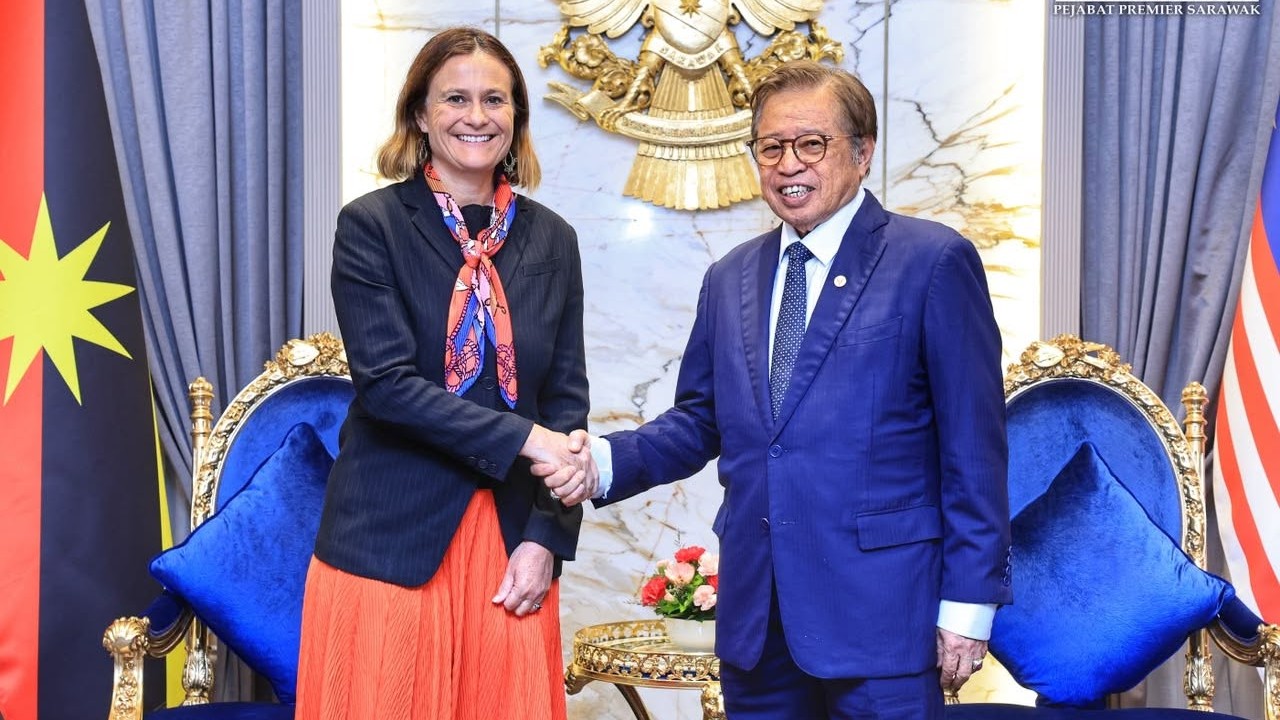
Australian High Commissioner to Malaysia Danielle Heinecke visited Sarawak last week, attending the 2nd Borneo Economic Community Forum in Kuching and participating in an exchange of letters with Sarawak Energy Berhad Group Chief Executive Officer Datuk Haji Sharbini Suhaili. The exchange marked the next phase of bilateral energy cooperation under Australia's Partnerships for Infrastructure (P4I) initiative.
Heinecke also met Sarawak Premier Datuk Patinggi Tan Sri Abang Johari Tun Openg to discuss opportunities to strengthen ties in investment, renewable energy and education. Her engagements included meetings with Minister for Tourism, Creative Industry and Performing Arts Sarawak Dato Sri Abdul Karim Rahman Hamzah, Chief Political Secretary to the Premier Dato Fazzrudin Rahman, Pending assemblywoman Violet Yong, Petroleum Sarawak Berhad (PETROS) chief executive officer Dato Janin Girie and Invest Sarawak chief executive officer Timothy Ong.
The discussions reflect growing interest in aligning Australian expertise with Sarawak's development priorities, particularly as the state seeks to expand its energy capabilities and strengthen its position as an industrial and investment destination in Southeast Asia.
Energy storage is a particularly important area of potential cooperation. While Sarawak has substantial hydropower resources, integrating increasing amounts of renewable energy into a modern electricity system requires careful planning, flexibility and the ability to balance supply with demand.
Energy storage technologies can help address these challenges by storing electricity when supply is abundant and releasing it when demand rises. Options include battery systems and pumped-storage hydropower, which uses electricity to pump water to a higher reservoir before releasing it through turbines to generate power when needed.
Australia has experience across several relevant areas, including batteries, solar and wind energy, as well as energy-market development and grid integration. Cooperation could help Sarawak assess which technologies are suitable for its energy system, identify commercially viable projects and develop the technical capabilities needed to operate them.
The collaboration builds on earlier work under Partnerships for Infrastructure. In March 2025, Australia and Sarawak agreed to undertake strategic analysis of energy storage technologies, their integration into existing systems and the policies required to support their deployment. The initiative was intended to help Sarawak Energy evaluate suitable technologies, model storage requirements and support investment in renewable energy.
The next phase offers an opportunity to build on that foundation, although the exchange of letters announced during the latest visit does not, by itself, establish a new investment amount or confirm a specific commercial project.
The economic relationship already has a foundation in trade and education. In July 2024, Heinecke said Australia-Sarawak trade was worth approximately A$1.87 billion (around US$1.25 billion), with aluminium ores and concentrates among the main components. Education is another established connection, supported by Australian institutions including Swinburne University of Technology Sarawak Campus in Kuching and Curtin University Malaysia in Miri.
These links provide a platform for expanding cooperation beyond traditional trade into higher-value activities, including engineering, energy technology, research, technical training and industrial development.
For Sarawak, the opportunity is not simply to adopt new technologies but to build local expertise and strengthen the industries that support them. Energy storage projects can require specialised engineering, system integration, monitoring, maintenance and workforce training. Partnerships that combine technology with skills development could help local companies and professionals participate in a growing clean-energy supply chain.
For Australian businesses, Sarawak offers a potential partner in a region where energy infrastructure, industrial growth and decarbonisation are increasingly interconnected. Collaboration could extend to renewable energy systems, grid management, hydrogen, energy efficiency and other areas where Australia has relevant capabilities and Sarawak is exploring development opportunities.
The wider regional dimension is also significant. The Borneo Economic Community Forum, held in Kuching on October 7 and 8, brought together policymakers, investors and business leaders to discuss connectivity, energy security, infrastructure and economic integration across Borneo. Its agenda included the development of a Borneo grid to support regional growth and electricity connectivity.
Improved cross-border electricity links could eventually support more efficient use of regional energy resources, although realising that potential would require infrastructure investment, regulatory coordination and agreements between the relevant jurisdictions.
Education and tourism also remain part of the bilateral agenda. Australian universities already have a presence in Sarawak, while stronger institutional and business links can create opportunities for student mobility, research partnerships and professional training. Tourism cooperation offers another channel for strengthening people-to-people connections and commercial engagement.
The latest visit demonstrates that Australia-Sarawak relations are increasingly focused on practical economic cooperation. The next test will be whether discussions and technical assessments can lead to bankable projects, stronger local capabilities and investment that delivers measurable benefits to both sides.
As Sarawak continues to develop its energy and industrial sectors, Australia's experience in renewable technologies and infrastructure planning could provide a useful complement to the state's resources and ambitions. The potential gains will depend on turning that complementarity into long-term commercial partnerships, with clear outcomes for energy security, industrial competitiveness and regional growth.