

Japan - New Zealand: Closer Strategic Ties Ahead of 75th Diplomatic Anniversary
Japan and New Zealand are looking to deepen their strategic partnership as security cooperation expands across the Indo-Pacific. Bilateral trade reached NZ$9.2 billion (approximately US$5.5 billion) in 2025, while new defence agreements are strengthening military logistics and information sharing.
Japan and New Zealand have reaffirmed their commitment to closer diplomatic and security cooperation ahead of the 75th anniversary of diplomatic relations in 2027, as both countries seek to reinforce regional stability and advance a free and open Indo-Pacific.
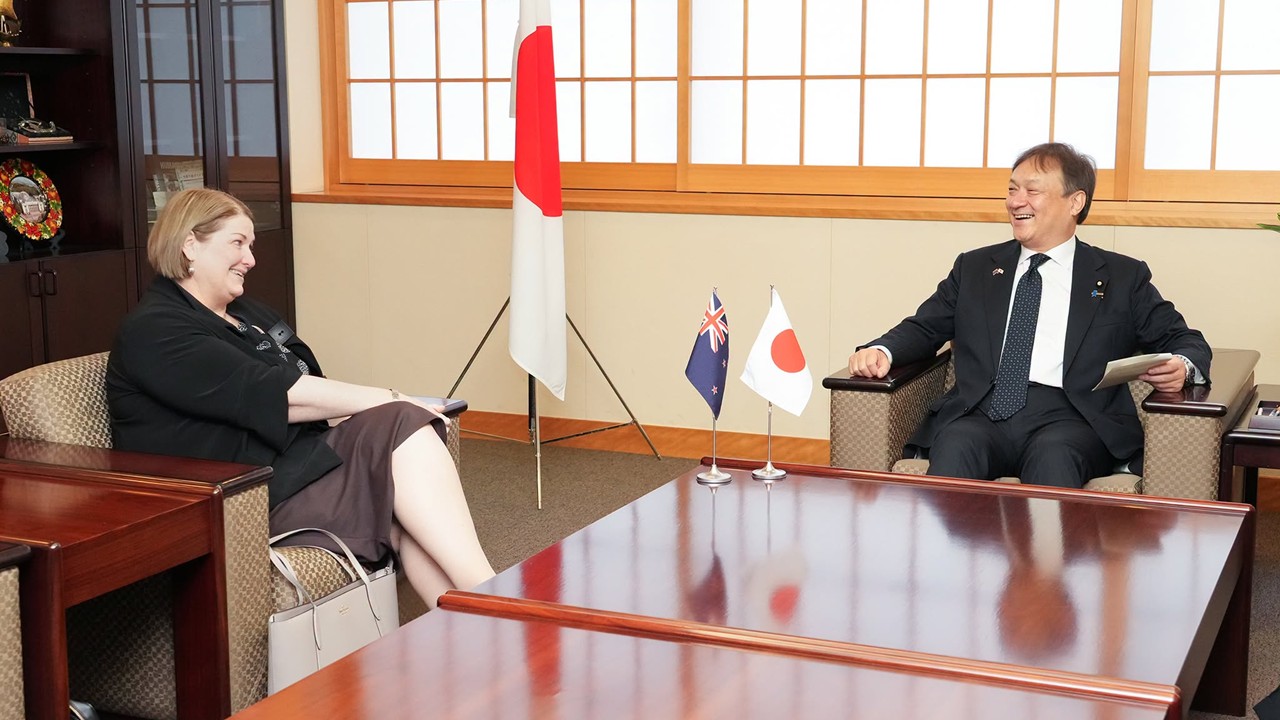
On October 19, Japan's State Minister for Foreign Affairs, HORII Iwao, received New Zealand's Ambassador to Japan, Carolyn Jane Weatherall Schwalger, for a courtesy call in Tokyo. The approximately 30-minute meeting focused on the bilateral strategic partnership, security and developments in the Pacific Islands region.
Horii congratulated Schwalger on her appointment and expressed Japan's intention to work closely with New Zealand towards realising its updated Free and Open Indo-Pacific (FOIP) vision. Schwalger, in turn, expressed her desire to further strengthen the two countries' Strategic Cooperative Partnership in the run-up to next year's anniversary.
The meeting comes as Japan and New Zealand move to translate their shared strategic interests into more practical defence cooperation while maintaining strong economic ties.
The economic relationship provides a substantial foundation for that partnership. Two-way trade in goods and services reached NZ$9.2 billion (approximately US$5.5 billion) in the year ended December 2025, making Japan New Zealand's fifth-largest trading partner and fourth-largest export market during the period.
Trade is supported by complementary economic strengths. New Zealand supplies Japan with dairy products, horticultural produce, aluminium, meat and forestry products, while Japanese exports to New Zealand include motor vehicles, machinery, mineral fuels and electrical equipment.
Goods accounted for NZ$8.08 billion (approximately US$4.8 billion) of the total, with services contributing NZ$1.12 billion (approximately US$670 million). Tourism and other commercial services remain important components of the relationship, alongside established supply chains in manufacturing and agriculture.
Investment also provides scope for deeper economic engagement. Japanese direct investment in New Zealand reached a cumulative NZ$8.828 billion (approximately US$5.3 billion) in the year ended March 2025. The established investment relationship, alongside cooperation on supply-chain resilience and economic security, offers opportunities to expand commercial ties as both countries navigate an increasingly uncertain international environment.
Security cooperation has also made significant progress. In December 2025, Japan and New Zealand signed two agreements designed to strengthen their defence relationship: an Acquisition and Cross-Servicing Agreement (ACSA) and an Information Security Agreement.
The ACSA establishes arrangements for the reciprocal provision of supplies and services between Japan's Self-Defense Forces and the New Zealand Defence Force. Such arrangements can facilitate logistical support during joint exercises and other agreed activities, helping the two militaries work together more effectively.
The Information Security Agreement establishes protections for classified information exchanged between the two governments, providing a framework for closer security cooperation and more effective information sharing. It entered into force in March 2026, while the ACSA took effect on August 15, 2026.
The two countries have also stepped up practical military engagement. At a defence ministerial meeting in May 2026, Japan and New Zealand welcomed a joint exercise involving the Japan Maritime Self-Defense Force and the Royal New Zealand Navy, noting that it had improved interoperability. Both sides agreed to continue working together through similar exercises.
Their discussions have also included cooperation with Pacific Island countries, including through the Japan-Pacific Islands Defense Forum and the South Pacific Defence Ministers' Meeting. Japan has separately expressed interest in sharing information with New Zealand as it considers options to replace its ANZAC-class frigates, with Japan's upgraded Mogami-class frigate among the candidates under consideration.
For both governments, the Pacific Islands region is an important part of the wider Indo-Pacific strategic environment. Cooperation on maritime security, defence readiness and regional engagement complements their broader commitment to a rules-based regional order.
The October 19 meeting did not announce new trade targets or defence initiatives. Instead, it reaffirmed the political commitment to sustain cooperation across diplomacy, security and economic affairs as the anniversary approaches.
With diplomatic relations due to reach 75 years in 2027, Japan and New Zealand have an opportunity to use the milestone to give fresh momentum to a partnership that increasingly connects commercial interests with regional security and strategic coordination.