

Central Force, APU partner to accelerate AI commercialisation and strengthen Malaysia's innovation ecosystem
Central Force International and the Asia Pacific University of Technology & Innovation (APU) have signed a two-year partnership aimed at bridging the gap between academic research and commercial application, supporting Malaysia's ambition to become an AI-ready nation while addressing the country's low rate of university research commercialisation.
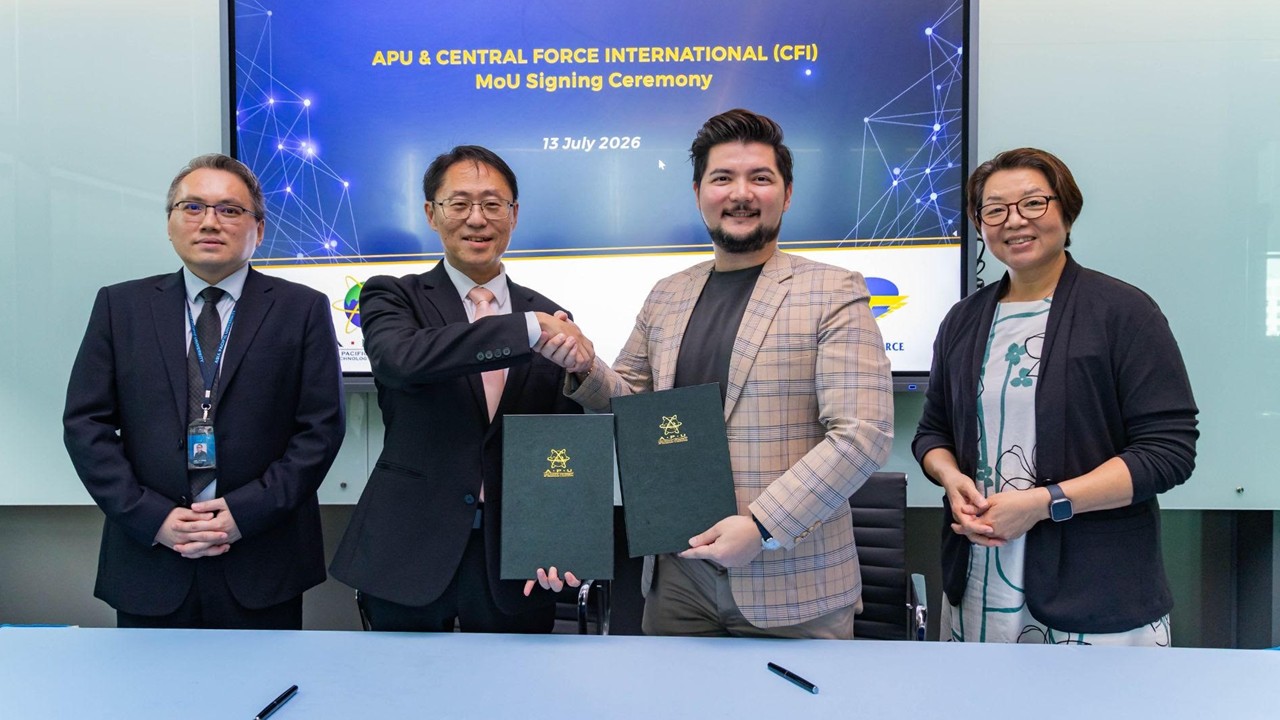
KUALA LUMPUR – Malaysia's drive to become an artificial intelligence powerhouse received a boost with the signing of a strategic partnership between Central Force International and the Asia Pacific University of Technology & Innovation (APU), as both organisations seek to transform university research into commercially viable AI solutions.
The two-year Memorandum of Understanding (MOU) brings together APU's expertise in research and technology with Central Force International's capabilities in market research, artificial intelligence and data analytics. The collaboration is designed to accelerate innovation while creating greater opportunities for students and researchers to work on real world industry challenges.
The partnership comes as Malaysia intensifies efforts to build an AI-driven economy under the Thirteenth Malaysia Plan (13MP), which places greater emphasis on developing homegrown technologies and reducing dependence on imported innovation.
Initial projects will focus on AI powered market research, survey automation, natural language processing (NLP) and behavioural analytics. These technologies are expected to help businesses and public institutions improve decision making by analysing large volumes of data more efficiently, understanding consumer behaviour and monitoring shifts in public sentiment.
The collaboration also addresses one of Malaysia's long-standing innovation challenges. According to the Ministry of Science, Technology and Innovation, only around 10 per cent of university research and development outcomes had been successfully commercialised as of 2025, highlighting the gap between academic discovery and market adoption.
Industry experts have identified limited commercial funding, entrepreneurial capability and sustained industry mentorship as key barriers preventing promising research from reaching the marketplace.
By creating closer collaboration between academia and industry at an earlier stage, the partnership aims to improve the commercial potential of research while equipping students with practical experience that enhances their employability.
The agreement includes joint applications for research and development grants, student internships, academic exchanges, guest lectures, collaborative research projects and knowledge sharing between university researchers and industry practitioners.
Central Force International Chief Executive Officer See Toh Wai Yu said Malaysia's ambition to become an AI driven nation depended on stronger collaboration between universities and businesses.
"Malaysia's ambition to become an AI driven nation cannot be achieved by treating academic research, industry needs and talent development as separate tracks. Businesses bring live challenges and market signals, while universities contribute research rigour, technical expertise and the next generation of talent.
"Through this partnership, we want to give students and academics opportunities to work on real research problems while helping businesses benefit from stronger expertise and more innovative approaches to understanding markets and society. The objective is not simply to study new technologies, but to determine how they can be applied responsibly and effectively," he said.
APU Vice Chancellor Professor Dr Ho Chin Kuan said the collaboration reinforces the university's long-standing commitment to ensuring that higher education remains closely aligned with industry requirements.
"We have always placed strong emphasis on ensuring that learning remains relevant to industry needs. This collaboration will give our students and academics greater opportunities to apply their knowledge to emerging areas such as AI driven market research, while contributing directly to business, innovation and wider societal needs that may support future innovation.
"The partnership reinforces our commitment to developing industry ready talent and ensuring that academic expertise contributes meaningfully to Malaysia's wider innovation ecosystem," he said.
Beyond research collaboration, both organisations intend to explore pathways for validating promising technologies against market demand and supporting their commercial development. This includes leveraging APU's entrepreneurship and incubation ecosystem alongside Central Force International's expertise in market strategy and commercialisation.
The initiative also aligns with the Malaysia Higher Education Blueprint 2026–2035, which encourages stronger collaboration between universities and industry to produce graduates equipped with the technical, analytical and practical skills needed in an increasingly digital economy.
As governments across Asia race to build domestic AI capabilities, partnerships between universities and industry are becoming increasingly important in transforming research into products and services that generate economic value.
For Malaysia, strengthening this innovation pipeline could play a significant role in achieving its ambition of becoming an AI-ready nation by 2030, while fostering a new generation of researchers, entrepreneurs and technology companies capable of competing in regional and global markets.