Malaysia opens Aichi-Nagoya Asian Games campaign with Six-Gold target, questions remain over contingent size
Malaysia has set a target of six gold medals and 33 medals overall at the Aichi-Nagoya Asian Games, with expectations focused on established medal sports following a strong SEA Games campaign, although questions have emerged over the size of the contingent.
NAGOYA — Malaysia has formally welcomed its contingent to the 20th Asian Games Aichi-Nagoya 2026, entering the continental Games with a target of six gold medals and 33 medals overall after a strong showing at last year’s SEA Games.
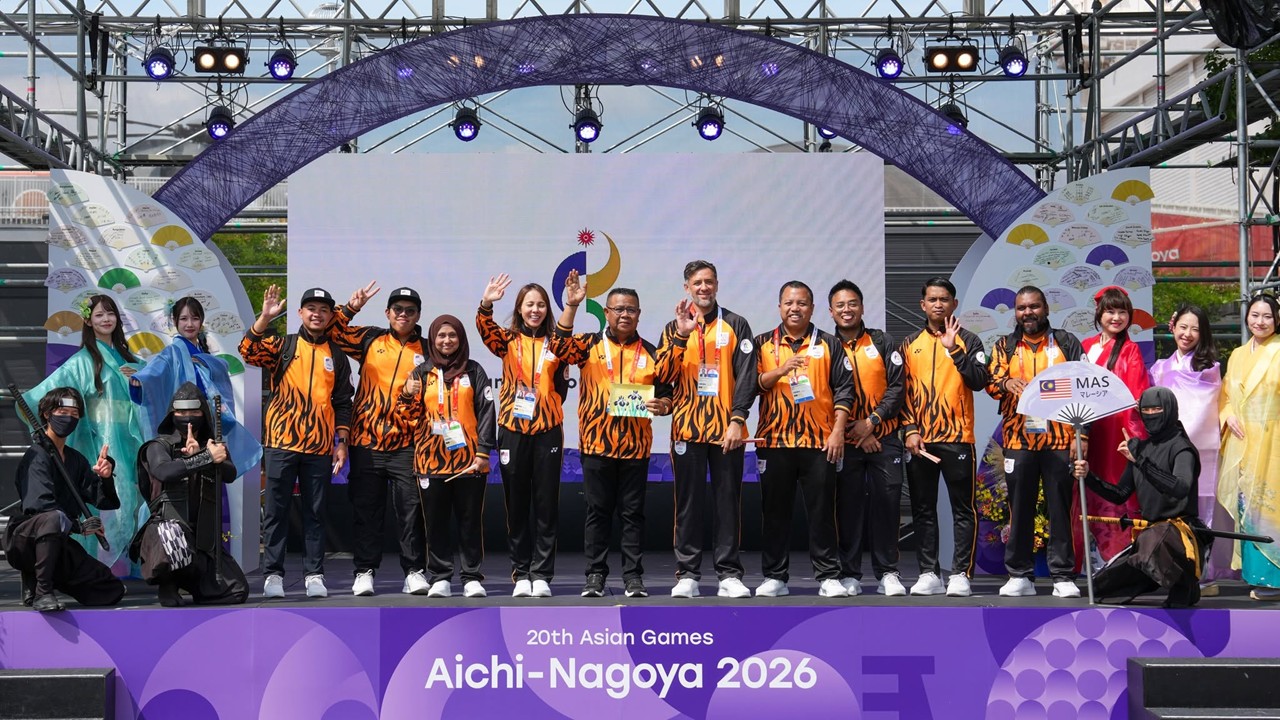
The Malaysian contingent was represented at the Team Welcome Ceremony on Friday, September 18, by a 10-member delegation led by Chef de Mission Datuk Mohd Sumali Reduan, Vice President of the Olympic Council of Malaysia and president of the Malaysian Sepaktakraw Federation.
The delegation included Deputy Chefs de Mission Mohamad Azlan Iskandar, a former Asian Games squash gold medallist, and Syaidatul Afifah Badrul Hamidi, a former Asian Games tenpin bowling gold medallist, alongside representatives from the Olympic Council of Malaysia, National Sports Council and National Sports Institute.
The ceremony, held at the Athletes’ Interaction Area at Athletes Plaza, Garden Pier, was officiated by Naoki Matsui, Acting Director General of the Aichi-Nagoya Asian Games Organising Committee. Malaysia was among six National Olympic Committees welcomed during the ceremony, alongside Laos, Pakistan, Singapore, Tajikistan and Vietnam, as well as the OCA Refugee Team.
The formal welcome comes as Malaysia prepares for competition from September 19 to October 4 with a 537-member delegation comprising 352 athletes and 185 officials. The athletes will compete in 30 of the 43 sports on the Asian Games programme and in 156 of the 469 medal events.
Malaysia's official medal target is six gold, seven silver and 20 bronze medals, giving an overall target of 33 medals. The target was set after assessments of current athlete form, recent performances, medal potential and the strength of Asian competition.
The 13 sports identified as having medal potential are track cycling, badminton, archery, diving, squash, sepak takraw, hockey, athletics, sailing, karate, wushu, esports and shooting. Officials have also indicated that Malaysia would welcome medals beyond the formal target.
Among the sports carrying significant expectations are track cycling, badminton, squash, diving, wushu and sepak takraw, while archery, shooting, sailing and hockey also form part of the country's identified medal prospects.
Track cycling veteran Datuk Azizulhasni Awang is among the athletes expected to contribute to Malaysia's medal challenge, while badminton will also attract considerable attention following the recent form of the country's leading players. The men's doubles combination of Goh Sze Fei and Nur Izzuddin Rumsani has publicly targeted the Asian Games title, adding another high-profile medal prospect to the Malaysian campaign.
The backdrop to the campaign is Malaysia's improved performance at the 2025 SEA Games in Thailand, where the country won 57 gold, 57 silver and 117 bronze medals for a total of 231 medals. The performance represented a substantial improvement from Malaysia's 2023 SEA Games haul of 34 gold, 45 silver and 97 bronze medals.
That performance has inevitably raised questions about the scale of Malaysia's Asian Games participation, particularly given the depth demonstrated across numerous sports at the SEA Games.
Some observers have questioned whether a 352-athlete delegation is relatively small in the context of Malaysia's recent regional performance, especially when compared with the breadth of sports that contributed medals in Thailand. At the 2025 SEA Games, 28 sports contributed gold medals, according to National Sports Council director-general Jefri Ngadirin, while 255 of 646 new faces in the Malaysian delegation returned with medals.
The comparison, however, also highlights the fundamentally different competitive environment. The Asian Games bring together the strongest athletes from across the continent, including major sporting powers such as China, Japan and South Korea, while Malaysia's own officials have stressed that success at the SEA Games cannot simply be transferred to the Asian level.
Chef de Mission Mohd Sumali has described the six-gold target as realistic while acknowledging that the Asian Games represent a significantly higher level of competition. Youth and Sports Minister Dr Mohammed Taufiq Johari has likewise said the target was based on assessments of preparations, athlete capabilities and commitments from the national sports associations.
For Malaysia, the challenge in Aichi-Nagoya is therefore not simply to reproduce its SEA Games medal haul but to convert its strongest regional performers into medals against deeper continental fields.
The opening of the Games also provides an opportunity for Malaysia's established medal sports to demonstrate whether their recent progress can translate onto the Asian stage. Track cycling, badminton, squash, diving, wushu and sepak takraw will be closely watched, while athletes in archery, athletics, sailing, karate, shooting, hockey and esports could provide additional medals.
Following the welcome ceremony, the Malaysian delegation joined representatives from other National Olympic Committees in the Asia Unity Tree Planting Session, organised around the themes of peace, friendship, unity and sustainability.
With the Games officially opening on Saturday, Malaysia now moves from preparation to competition, with six gold medals and 33 medals overall as the formal benchmark, while the country's recent SEA Games performance provides both a source of confidence and a basis for wider expectations.