

Erdoğan and Sharif Reaffirm Defence Ties as Mecca Pact Gains Momentum
Türkiye and Pakistan have pledged closer defence and regional cooperation following talks at COP31 in Antalya, with their trilateral Mecca Joint Defence Agreement with Saudi Arabia establishing a new framework for collective security.
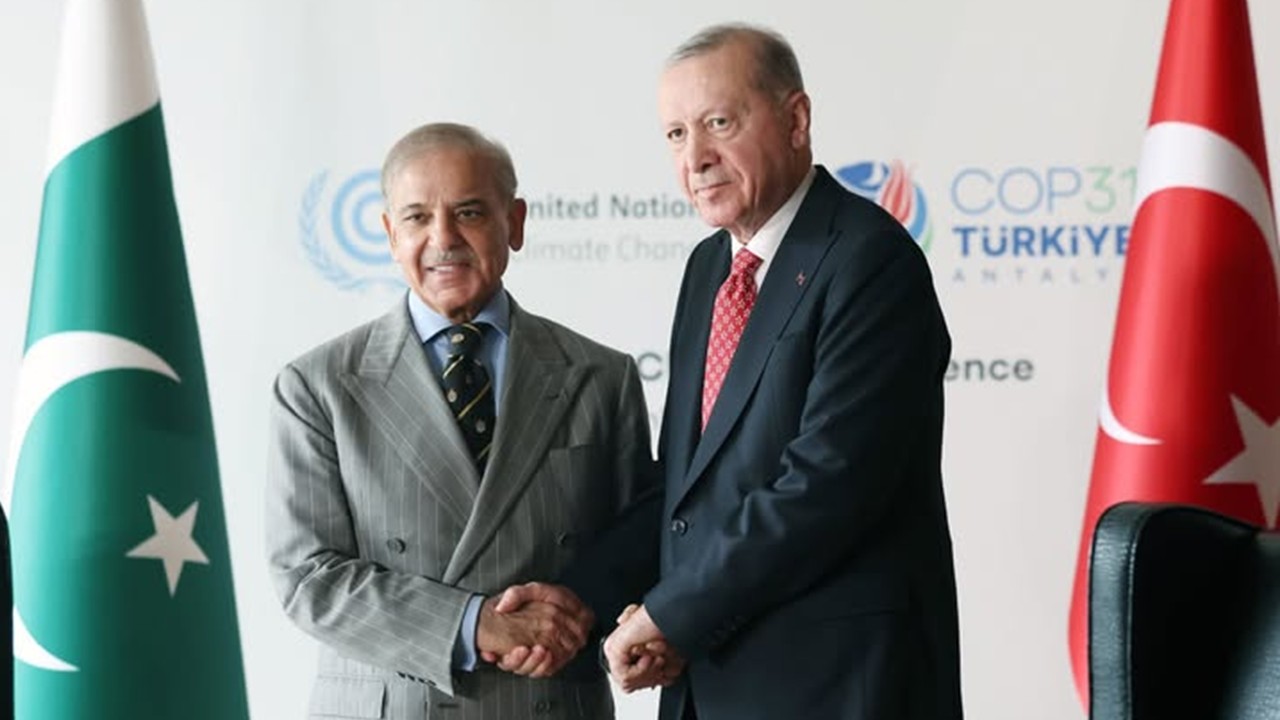
ANTALYA – Turkish President Recep Tayyip Erdoğan and Pakistani Prime Minister Shehbaz Sharif have reaffirmed their commitment to strengthening bilateral relations and regional security, as the recently established Mecca Joint Defence Agreement between Türkiye, Pakistan and Saudi Arabia moves towards implementation.
The two leaders met on the sidelines of the 31st Conference of the Parties to the United Nations Framework Convention on Climate Change (COP31) in Antalya, where discussions covered bilateral relations, regional security and international developments.
Erdoğan said Türkiye would continue taking steps to give fresh momentum to its relationship with Pakistan, with efforts to accelerate cooperation across several sectors, particularly transportation and the defence industry.
He said the Mecca Defence Alliance had further strengthened solidarity between the two countries, adding that Ankara and Islamabad would continue contributing jointly to efforts to end the conflict in Iran.
Erdoğan also said Türkiye was prepared to do its utmost, through peaceful means, to help address the challenges Pakistan faces in its region.
The Turkish president extended his condolences to Sharif following an attack on a police convoy in Pakistan that resulted in fatalities.
The meeting comes at a significant moment for the three countries, following the signing of the Mecca Joint Defence Agreement by Erdoğan, Sharif and Saudi Crown Prince and Prime Minister Mohammed bin Salman on August 7.
The agreement establishes a collective defence framework under which an armed attack against any one of the three countries is to be regarded as an attack against all three. It also provides for closer military cooperation, collective deterrence and stronger coordination across defence-related areas.
Türkiye's parliament approved ratification of the agreement on November 6, with 279 lawmakers voting in favour and 119 against, marking an important step towards formalising the trilateral arrangement.
The agreement has attracted considerable attention because of its mutual-defence provision, which has been compared with Article 5 of the North Atlantic Treaty Organisation (NATO). However, Turkish officials have emphasised that the arrangement is defensive in nature and is not directed against any particular country.
Importantly, the agreement does not mean an automatic deployment of Turkish troops. Turkish parliamentary representatives have clarified that any deployment of armed forces abroad would require separate parliamentary authorisation.
The pact's development comes against a backdrop of heightened regional tensions, including the conflict involving Iran, security threats affecting Saudi Arabia and continuing instability around Yemen and the Red Sea.
Turkish Foreign Minister Hakan Fidan has previously defended the agreement as a framework for collective security, while indicating that countries sharing its objectives could potentially participate in wider regional cooperation.
The agreement also provides a platform for deeper defence-industry collaboration, intelligence cooperation and the development of military capabilities among the three signatories.
For Pakistan, the arrangement strengthens its strategic relationship with two important regional partners, while Türkiye brings substantial defence-industrial capabilities and Saudi Arabia contributes significant economic and strategic weight.
The three countries have increasingly emphasised the importance of regional solutions to regional security challenges, rather than relying exclusively on external powers.
At the Antalya meeting, Sharif also highlighted the importance of regional countries, particularly members of the Mecca agreement, continuing efforts to promote de-escalation and dialogue.
According to Pakistan's Prime Minister's Office, Sharif thanked Erdoğan for Türkiye's support and close coordination during Pakistan's diplomatic efforts, including initiatives involving the United States and Iran under the Islamabad Memorandum of Understanding.
Both leaders stressed the importance of all parties honouring their commitments under the Islamabad MoU to secure lasting peace in the wider region.
The meeting demonstrates how the Türkiye-Pakistan relationship is expanding beyond traditional diplomatic and economic cooperation, with defence coordination and regional diplomacy becoming increasingly important components of their strategic partnership.