

Bangladesh and Kosovo Look to Trade, Investment and Labour Mobility to Deepen Bilateral Ties
Bangladesh and Kosovo are moving to deepen bilateral ties through trade, investment, labour mobility and wider economic cooperation, with both sides exploring a possible free trade agreement and new mechanisms to support business links.
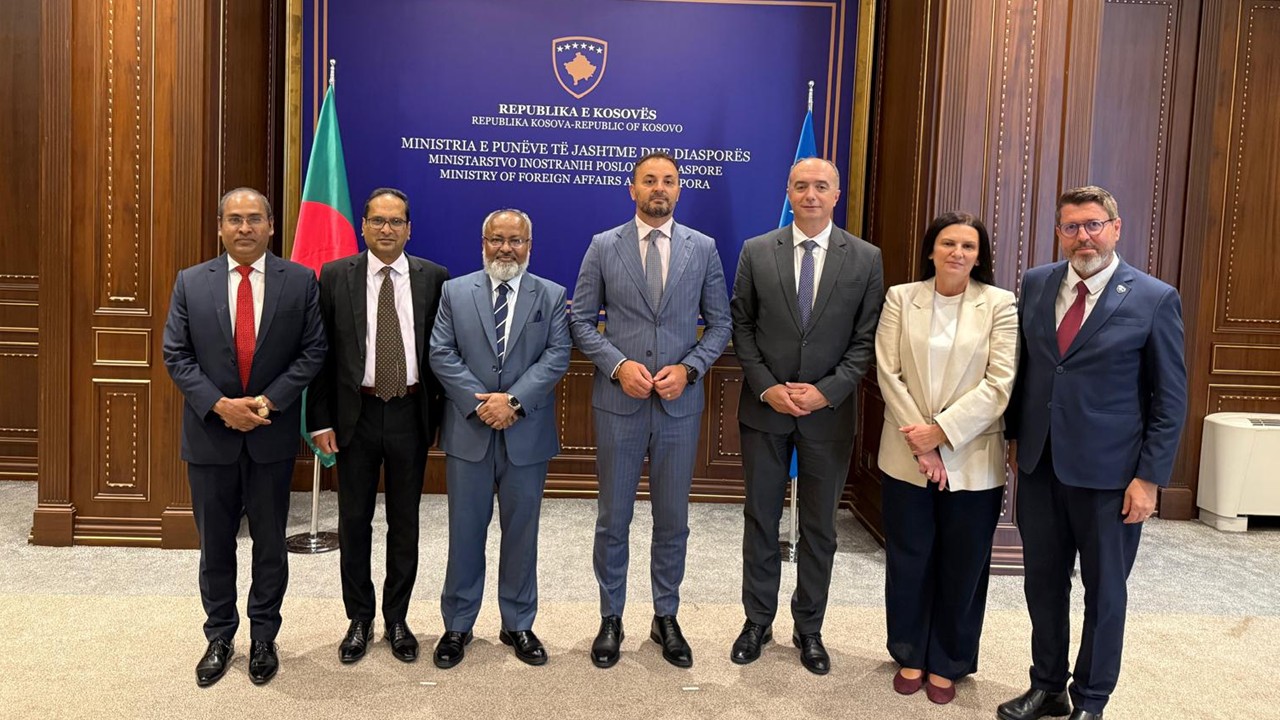
Prishtina, Kosovo: Bangladesh and Kosovo are looking to broaden their bilateral relationship beyond political engagement, with trade, investment, labour mobility, education, technology and tourism emerging as key areas for deeper cooperation.
The direction was set during the second Bangladesh–Kosovo Foreign Office Consultations, held in Prishtina on 13 August, where the two sides reviewed the full range of bilateral relations and discussed practical measures to expand economic and institutional links.
The Bangladeshi delegation was led by Dr M. Nazrul Islam, Secretary for Bilateral Affairs (East and West) at the Ministry of Foreign Affairs, while Kosovo's delegation was headed by Ilir Muçaj, Secretary General of the Ministry of Foreign Affairs and Diaspora.
Both sides expressed satisfaction with progress since the establishment of diplomatic relations and reaffirmed their commitment to developing closer ties based on mutual respect, common interests and international law.
A significant part of the discussions focused on areas where the two economies see untapped potential. These include trade and investment, education, agriculture, information and communication technology, tourism, labour mobility and wider people to people exchanges.
Labour mobility emerged as one of the most immediate opportunities. Bangladesh and Kosovo agreed to explore a government to government mechanism for the recruitment and employment of Bangladeshi workers in Kosovo. The proposed framework is intended to make labour migration more transparent, orderly and mutually beneficial as demand for workers grows.
The discussions also pointed towards a more ambitious economic relationship, with both countries examining the possibility of initiating a bilateral Free Trade Agreement. Such an agreement could provide a framework for expanding two way trade and creating new opportunities for businesses in both markets.
Bangladesh is seeking greater access for some of its major export sectors, including ready made garments, jute and jute products, ceramics and pharmaceuticals. Dhaka also invited Kosovan investors to explore opportunities in Bangladesh's Special Economic Zones.
The two sides discussed establishing a Joint Working Group on Trade and Economic Cooperation and agreed on the importance of stronger private sector engagement and business delegation exchanges. Discussions also covered closer links between the Kosovo Chamber of Commerce and the Dhaka Chamber of Commerce.
Kosovo, meanwhile, highlighted its position as a potential gateway to wider European markets. Its proximity to the European Union, competitive workforce and access to regional trading arrangements including CEFTA and EFTA were presented as factors that could make Kosovo more attractive to Bangladeshi companies looking to expand into Europe and the Western Balkans.
The two governments also stressed the importance of concluding bilateral agreements currently under negotiation, particularly arrangements covering economic cooperation and the avoidance of double taxation.
The consultations therefore point to a relationship increasingly shaped by economic interests. For Bangladesh, stronger links with Kosovo could create additional routes into European markets while supporting overseas employment opportunities for its workforce. For Kosovo, deeper engagement with Bangladesh offers access to one of Asia's major manufacturing and labour markets.
The next phase will depend on turning the political understanding reached in Prishtina into practical mechanisms, including trade negotiations, business exchanges and a structured approach to labour recruitment.
The second Foreign Office Consultations suggest that Bangladesh and Kosovo are seeking to move their relationship from diplomatic engagement towards a more commercially focused partnership, with trade, investment and people to people links at its centre.