

Fiji and Korea Deepen Partnership as Energy Security Takes Centre Stage
Fiji is seeking to deepen its 55 year relationship with South Korea, with energy security, resilient supply chains, renewable technology, climate cooperation and the planned return of a Fiji diplomatic mission to Seoul emerging as key areas for closer engagement.
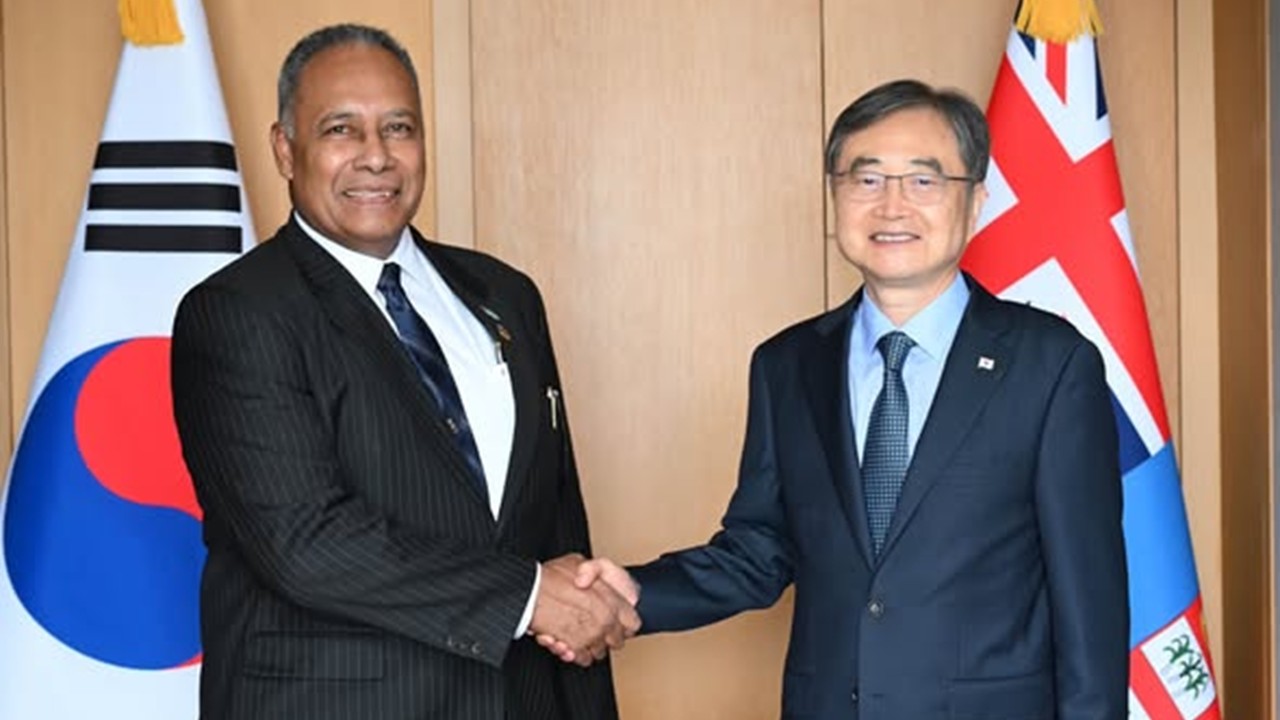
Fiji and the Republic of Korea are looking to take their longstanding relationship into a new phase, with energy security and resilient supply chains emerging as central priorities during Fiji's first foreign ministerial visit to Korea in almost a decade.
During his official engagements in Seoul, Fiji's Minister for Foreign Affairs and External Trade, Sakiasi Raisevu Ditoka, met the Minister of Foreign Affairs of the Republic of Korea, Cho Hyun, as the two countries mark 55 years of diplomatic relations.
Ditoka conveyed the greetings of Fiji Prime Minister Sitiveni Rabuka and the Government and people of Fiji, while expressing appreciation for the warm reception extended to his delegation. The meeting covered developments on the Korean Peninsula and in the Pacific, but a significant part of the discussion focused on the uncertainty surrounding global energy supplies amid continuing conflict in the Middle East.
For Fiji, the issue has immediate economic and strategic implications. As an island nation heavily dependent on imported petroleum products, disruptions to international shipping, freight, insurance and fuel markets can quickly affect domestic prices, economic activity and the daily lives of its people.
The country's role as a fuel and logistics hub for parts of the Pacific adds another dimension. Disruptions affecting Fiji's own supply chains can also have consequences for neighbouring Pacific island countries that depend on fuel moving through Fiji.
Against this backdrop, Ditoka raised the possibility of establishing a more structured bilateral framework on fuel and energy security. The discussions also extended beyond petroleum to areas where Korean expertise could support Fiji's longer term energy transition, including renewable energy, battery storage and smart grid technology.
The energy discussions were reinforced through a separate engagement with Korea's energy authorities. Ditoka met Deputy Minister Ghi Wuk Yang, Deputy Minister for Trade, Industry and Resource Security, as well as Joo Suk Son, President and CEO of the Korea National Oil Corporation (KNOC). Those discussions focused specifically on strategic petroleum reserves, storage capacity, supply chain resilience and diversification.
South Korea's extensive experience in strategic petroleum reserves and fuel security provides Fiji with an opportunity to examine approaches that could be adapted to its own circumstances. KNOC has considerable technical expertise in strategic stockpiling and international energy arrangements.
A practical way forward was agreed, with officials from Fiji and Korea to establish focal points for technical discussions on strategic fuel reserve planning. Fiji's Department of Energy will engage directly with KNOC as the work progresses.
The aim is not to replicate Korea's system, but to determine what would be practical, affordable and sustainable for Fiji while strengthening the country's ability to withstand future disruptions.
At the same time, Fiji sees energy resilience as inseparable from its transition towards cleaner and more sustainable sources of energy. Greater security in petroleum supply is therefore being considered alongside renewable energy, energy storage and other technologies that could progressively reduce the country's dependence on imported fuel.
Climate change was also a major component of the discussions between the two foreign ministers. Ditoka invited Korea's Prime Minister and Foreign Minister to participate in the Pre-COP to be hosted by Fiji and Tuvalu in November, describing Korean participation as an important demonstration of solidarity with Pacific island states facing increasingly severe climate impacts.
The bilateral agenda extends well beyond energy and climate. Fiji and Korea also discussed opportunities in maritime development and the blue economy, shipbuilding and marine engineering, trade and investment, aviation, tourism, technology and skills development.
Existing Korean cooperation with Fiji is already supporting areas including health, renewable energy, rural development and climate resilient livelihoods, providing a foundation for broader economic and technical partnerships.
One of the most significant announcements from the visit was Fiji's decision to work towards October 2027 as the target date for re-establishing its diplomatic mission in Seoul.
For Fiji, the planned return of a permanent mission represents more than the reopening of an embassy. It is intended to provide a stronger platform for building commercial and institutional relationships, supporting Fijian interests, promoting trade and investment and identifying opportunities across the Korean market.
The move comes as both countries mark more than five decades of diplomatic relations and seek to increase the frequency and depth of official communication.
The recent energy discussions demonstrate why closer engagement is becoming increasingly important. Global crises can rapidly affect small island economies, but stronger bilateral relationships can provide access to expertise, technology and partnerships that improve resilience.
For Fiji and Korea, the next chapter of their relationship is therefore being shaped not only by diplomatic ties built over 55 years, but by practical cooperation in areas that will determine economic and energy resilience in the decades ahead.