

After market entry, the focus shifts to putting down roots in ASEAN
The 2026 Land-Sea Economic Forum has called for a shift from market entry to long term localisation, urging Chinese companies expanding into ASEAN to build deeper partnerships, local supply chains and sustainable business operations.
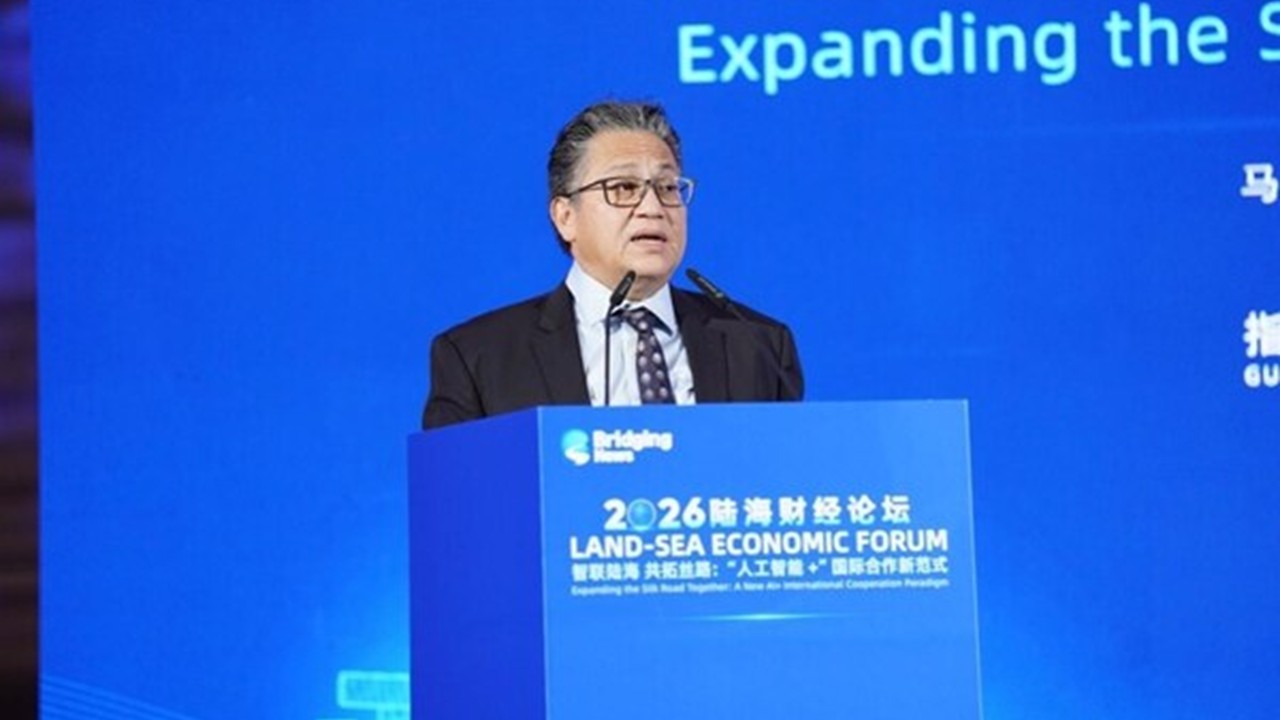
KUALA LUMPUR – Nearly 200 representatives from government, business, finance, think tanks and the media gathered in Kuala Lumpur for the 2026 Land-Sea Economic Forum, where discussions centred on how Chinese companies can move beyond market entry and establish a lasting presence across Southeast Asia.
Organised by the Western International Communication Organization (WCICO) and guided by the Information Office of the Chongqing Municipal People's Government, the forum highlighted the growing importance of artificial intelligence, cross border investment, digital industries and the New International Land-Sea Trade Corridor (ILSTC) in strengthening economic ties between China, Malaysia and ASEAN.
Malaysia's Deputy President of the Senate, Senator Datuk Nur Jazlan Mohamed, said the ILSTC has significantly reduced transport times between western China and Southeast Asian ports while artificial intelligence is transforming logistics, customs clearance, compliance and capital allocation.
Federation of Malaysian Manufacturing Deputy President Dato' Andrew Goh Boon Kim highlighted the role of artificial intelligence in improving supply chain resilience and visibility, while Professor Chee Seng Chan of the University of Malaya said AI can only deliver meaningful economic value when it is adapted to local market conditions.
Malaysia Digital Economy Corporation representative Ir. Wan Murdani Wan Mohamad outlined the country's newly launched Malaysia AI strategy and encouraged Chinese companies to use Malaysia as a regional hub for expansion into ASEAN.
A key outcome of the forum was the launch of the Bridging News Kuala Lumpur Station by WCICO and the Center for Advanced Studies & Research, alongside the release of a joint report examining how Chongqing and Malaysia can deepen localisation and jointly expand into ASEAN markets.
Presenting the report, Senior Researcher Dr Chang Peng Kee said successful international expansion requires businesses to move beyond simply entering new markets and instead invest in local production, local talent and stronger brand development.
"We do not land on Malaysia; we take root with it," he said.
Discussions on smart mobility, digital content and corporate globalisation reinforced the message that long term investment, technology transfer and partnerships with local businesses will be critical to future success.
Socio-Economic Research Centre Executive Director Lee Heng Guie called on Chinese investors to integrate into Malaysia's supply chains, develop local suppliers and create high value employment opportunities as part of a sustainable regional growth strategy.
The forum reflected the growing emphasis on localisation as the next phase of China-ASEAN economic cooperation, with policymakers and industry leaders agreeing that lasting success will depend not only on market access, but on building businesses that become part of the local economy.