

The Mecca Defence Pact: Three Powers, Three Capabilities and a Changing Security Order
An extended commentary by the Strategic Affairs Editor of News Desk Asia on the Mecca Joint Defence Agreement between Saudi Arabia, Türkiye and Pakistan comes at a pivotal moment in global security, as governments reassess defence spending, strategic autonomy and the need for stronger regional partnerships. With Saudi Arabia bringing financial strength, Türkiye an expanding defence industry and Pakistan significant military manpower and strategic capabilities, the agreement could become more than a mutual security pact
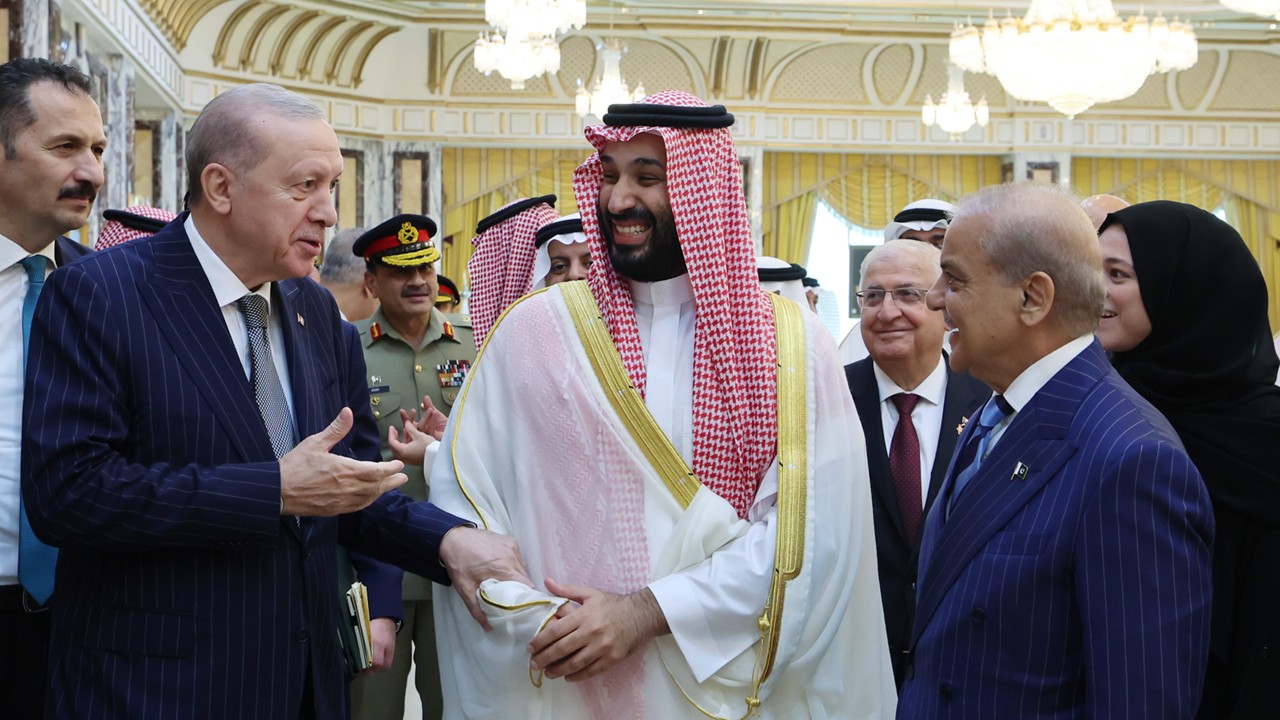
The signing of the Mecca Joint Defence Agreement by Saudi Arabia, Türkiye and Pakistan marks more than the creation of another regional security arrangement. It is a signal that the strategic map stretching from the eastern Mediterranean to the Gulf and South Asia is being redrawn at a time when the assumptions underpinning the post-Cold War security order are themselves under pressure.
Signed in Mecca on August 7 by Saudi Crown Prince Mohammed bin Salman, Turkish President Recep Tayyip Erdoğan and Pakistani Prime Minister Shehbaz Sharif, the agreement establishes the principle that an armed attack against one of the three will be regarded as an attack against all. The governments have presented it as defensive rather than directed against a particular country, while the precise operational commitments remain to be defined.
Its significance becomes clearer when viewed against a much broader development: countries across the world are reassessing how much they need to spend, produce and cooperate to provide their own security.
Europe is perhaps the clearest example. After sustained pressure from US President Donald Trump for NATO members to carry a much greater share of the alliance's defence burden, NATO leaders agreed at The Hague in 2025 to move towards spending 5% of GDP annually on defence and defence-related security by 2035. Of that, at least 3.5% is earmarked for core military requirements, while up to 1.5% can cover areas such as critical infrastructure, cyber security, resilience and defence-related infrastructure.
The European response is already substantial. EU member states are expected to spend about €454 billion on defence in 2026, equivalent to approximately 2.4% of combined GDP. That represents a 75.3% increase from 2021. Defence investment alone is expected to approach €163 billion this year, almost 159% higher than in 2021.
The EU has gone further than simply asking governments to increase their budgets. Through the Security Action for Europe, or SAFE, it has created a €150 billion lending mechanism to accelerate joint procurement of ammunition, missiles, air defence and ground combat systems. Its broader Readiness 2030 programme is intended to mobilise up to €800 billion in additional defence investment.
That is the critical lesson for the new Saudi-Türkiye-Pakistan relationship. Defence power in the 21st century is no longer simply a question of how many soldiers a country has or how many aircraft sit on its air bases. It is about whether a country can produce, finance, sustain and integrate military capability. On that measure, the three members of the Mecca agreement bring remarkably different strengths.
Saudi Arabia brings financial weight. According to SIPRI, the Kingdom spent approximately 6.5% of GDP on its military in 2025, making defence a much larger share of its economy than in either Türkiye or Pakistan. Saudi Arabia's military expenditure was about USD 83.2 billion.
Pakistan brings manpower, military experience and a nuclear deterrent. Its military spending was approximately 2.9% of GDP in 2025. Its challenge is not the absence of military capability, but the economic constraint of maintaining and modernising a large force while competing for resources with a much broader set of national priorities.
Türkiye brings perhaps the most important industrial component. Its military expenditure was approximately 1.9% of GDP under SIPRI's methodology in 2025, but the country has spent years building an increasingly sophisticated indigenous defence industry spanning unmanned systems, missiles, naval platforms, armoured vehicles and aerospace. Türkiye's position as a NATO member also gives the relationship an unusual strategic dimension.
Put simply, the three countries possess money, manpower and industrial capacity, although in different proportions. The question now is whether those strengths can be combined.
A military alliance can look impressive on paper and remain strategically limited if its members cannot communicate securely, share intelligence, move forces, replenish ammunition and operate common systems. The real test of the Mecca agreement will therefore not be the number of troops represented by its members, but the degree of interoperability they can achieve.
This is precisely where Europe's current defence transformation offers a useful comparison. European governments discovered that simply increasing national defence budgets does not automatically create a stronger European defence capability. Procurement can remain fragmented, weapons systems can be incompatible, industrial capacity can be duplicated and supply chains can remain dependent on external suppliers.
The EU is consequently trying to turn higher spending into collective capability through joint procurement, common standards and a stronger European defence industrial base. The same principle could determine whether the Saudi-Türkiye-Pakistan agreement becomes a historic strategic partnership or simply another diplomatic declaration.
There is also a striking economic dimension. The three countries together spent roughly USD 125 billion on defence in 2025, based on SIPRI figures. Saudi Arabia alone accounts for the majority of that total. Europe, by contrast, is moving towards €454 billion in annual defence expenditure. The scale is different, but the strategic question is remarkably similar: how can national spending be converted into collective security?
For Saudi Arabia, deeper cooperation could support the Kingdom's ambition to develop a more indigenous defence industry and reduce its long-term dependence on foreign suppliers. For Türkiye, the relationship potentially provides a major market and financing partner for its expanding defence industry, while deepening its strategic reach beyond its immediate neighbourhood. For Pakistan, it creates the possibility of greater access to investment, technology, industrial cooperation and training while reinforcing a strategic relationship with two major regional powers.
But there are vulnerabilities. The three militaries operate different weapons systems, doctrines and command structures. Their geographical separation is considerable. Their strategic priorities are not identical. Türkiye's NATO commitments must also be considered alongside its new trilateral commitments. And while the agreement establishes a powerful political principle, its practical meaning will depend on what happens when a real crisis tests it.
That is why the next phase matters more than the signing ceremony. If Riyadh, Ankara and Islamabad move towards joint exercises, intelligence sharing, integrated air and missile defence, common logistics, satellite surveillance, cyber cooperation and joint defence production, the agreement could evolve into something considerably more consequential than a mutual-security declaration. It could become the foundation of a new defence-industrial and strategic corridor linking South Asia, the Gulf and Türkiye.
That would also fit a wider global trend. Europe is responding to uncertainty by pooling resources and rebuilding industrial capacity. Asian powers are strengthening domestic defence production. Middle Eastern states are investing heavily in air defence, drones, missiles and strategic autonomy. Governments are increasingly recognising that security cannot be purchased indefinitely from someone else.
The Mecca agreement therefore deserves to be viewed in this wider context. It is not simply about Saudi Arabia, Türkiye and Pakistan. It is part of a global movement towards greater strategic self-reliance, defence-industrial sovereignty and regional security partnerships. The most important question is no longer how much these three countries spend individually. It is whether they can make their combined resources greater than the sum of their parts.
If they can, the Mecca agreement may eventually be remembered not as another regional pact, but as an early marker of a new security architecture emerging across Asia and the Middle East.