Financial Crime Fight Shifts Towards Intelligence, AI and Data
Financial institutions are facing a more technologically sophisticated criminal landscape, prompting regulators, banks and technology providers to place greater emphasis on data, artificial intelligence and intelligence-sharing.
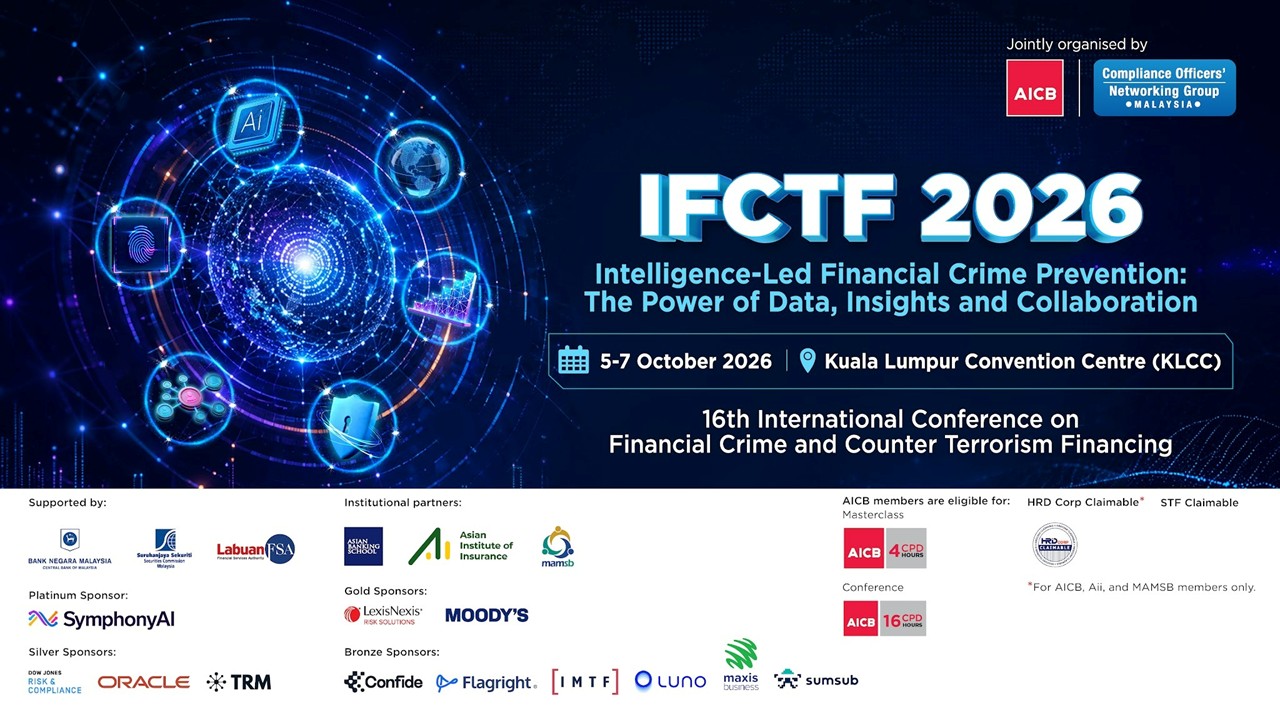
KUALA LUMPUR — Financial crime is becoming increasingly difficult to contain within individual institutions or national borders as criminal networks adopt artificial intelligence and other emerging technologies, putting greater pressure on banks and regulators to detect threats earlier and share intelligence more effectively.
The issue will take centre stage at the 16th International Conference on Financial Crime and Counter Terrorism Financing (IFCTF) 2026, which will be held at the Kuala Lumpur Convention Centre from Oct 5 to 7.
Organised by the Asian Institute of Chartered Bankers (AICB) and the Compliance Officers' Networking Group (CONG), the conference will bring together regulators, policymakers, financial institutions, law enforcement agencies and technology companies under the theme “Intelligence-Led Financial Crime Prevention: The Power of Data, Insights and Collaboration”.
The conference comes as financial institutions face an increasingly complex combination of fraud, financial crime and technology risks. Rather than relying solely on conventional compliance controls, the organisers say institutions need to develop stronger capabilities in data analytics, artificial intelligence and trusted intelligence-sharing across institutions, sectors and jurisdictions.
Edward Ling, chief executive officer of AICB, said financial crime was no longer confined to individual institutions or jurisdictions, with criminal networks using data and emerging technologies at increasing speed.
“Trusted intelligence-sharing and coordinated action” are therefore becoming increasingly important, he said, adding that IFCTF 2026 would examine how these capabilities could support earlier detection, stronger prevention and more effective responses.
The conference will also examine the human capabilities required to support intelligence-led financial crime prevention.
As banks and other institutions increase their use of data-driven systems, demand is growing for professionals with expertise spanning compliance, risk management, governance, technology and data analytics.
The technology dimension will also feature prominently, with financial crime technology providers showcasing tools aimed at improving fraud detection, investigations and regulatory compliance.
Among the companies supporting the conference are SymphonyAI as Platinum Sponsor, with LexisNexis Risk Solutions and Moody's among the Gold Sponsors.
The event continues a conference series that began in 2011 and has developed into a platform for financial crime practitioners to exchange knowledge and examine emerging risks.
For the financial sector, the challenge is increasingly becoming one of connecting information rather than simply collecting it. The effectiveness of intelligence-led prevention depends not only on the technology available to individual institutions, but also on the ability of organisations and authorities to share relevant information while maintaining appropriate governance, privacy and regulatory safeguards.
With financial crime networks becoming increasingly digital and cross-border, the conference is expected to focus attention on how data, technology and cooperation can be translated into practical tools for identifying suspicious activity before it develops into larger losses.