

Omnichannel Commerce Faces Growing Execution Gap as AI Reshapes Retail
A new global study by Anchanto and Demand Metric finds that enterprise brands and retailers are facing an “Omnichannel Execution Gap”, with disconnected systems, fragmented workflows and limited visibility undermining efforts to build more intelligent, AI driven commerce operations.
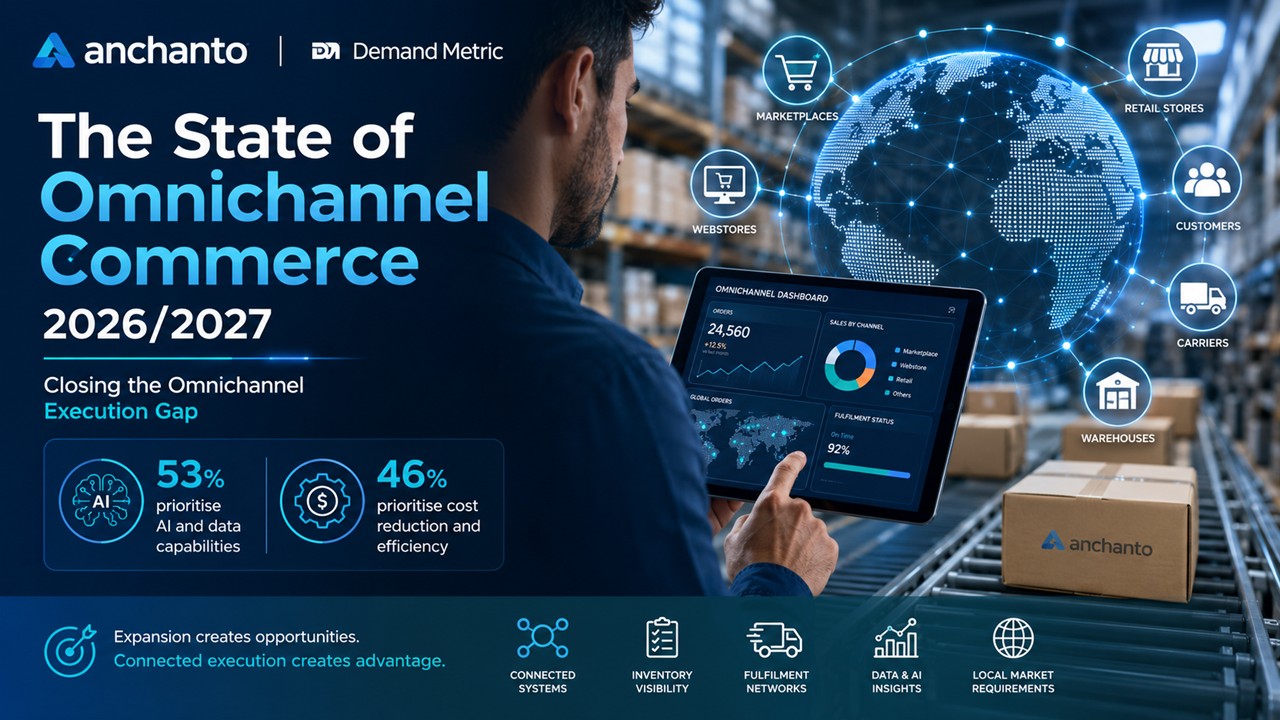
Enterprise brands and retailers are expanding rapidly across marketplaces, webstores and fulfilment networks, but a new global study has found that many are struggling to coordinate the systems, data and workflows needed to deliver a truly connected omnichannel operation.
The findings come from The State of Omnichannel Commerce 2026/2027, a global study released by Singapore headquartered SaaS company Anchanto in partnership with research and advisory firm Demand Metric.
The study identifies what it describes as the “Omnichannel Execution Gap” — the disconnect between how organisations perceive their omnichannel capabilities and their ability to execute consistently across channels, systems, inventory, fulfilment and markets.
While businesses have made significant progress in expanding their digital commerce presence, disconnected systems, fragmented workflows, limited operational visibility and continued reliance on manual coordination remain significant barriers to consistent execution.
“Brands and retailers have made significant progress in expanding across channels, marketplaces, and fulfilment models. But expansion alone does not create omnichannel maturity,” said Vaibhav Dabhade, Founder and CEO of Anchanto.
He said the next competitive advantage would come from connecting systems, inventory, workflows, fulfilment networks and local market requirements into a coordinated commerce operating model. AI is emerging as a major priority for organisations navigating this transformation. According to the study, 53% of respondents identified AI and data capabilities as a leading area of focus, ahead of cost reduction and efficiency at 46%.
The research suggests that businesses are increasingly looking beyond AI as a general technology trend and towards practical applications that can directly influence commerce performance. Among the most valuable use cases identified are promotion and pricing effectiveness, greater visibility into marketplace performance, and improved prediction of inventory and fulfilment requirements.
However, the study also highlights a fundamental limitation: AI cannot operate effectively without reliable data and connected systems.
Disconnected technology environments, fragmented data and manual processes can restrict organisations from applying AI consistently across their commerce operations, potentially limiting the returns from new investments in automation and intelligent technologies.
John Follett, Co-Founder and Head of Research at Demand Metric, said the research showed that omnichannel maturity could not be measured simply by the number of channels a company operates or by management confidence in its capabilities. “Many organisations have built extensive commerce ecosystems, but the systems, workflows, and data behind them are not yet fully coordinated,” he said.
Follett said organisations seeking to close the execution gap would need to examine their operational realities more closely and establish the connected foundations required to support automation, AI and continued growth. The findings point towards a broader shift in how omnichannel commerce is likely to be measured. Rather than focusing primarily on the number of channels available to consumers, the next stage of development is expected to centre on how effectively those channels operate together.
For retailers and brands managing increasingly complex regional and global operations, the ability to connect inventory, fulfilment, data, technology platforms and local market requirements could become increasingly important in controlling costs, protecting margins and delivering consistent customer experiences.
Anchanto, which is headquartered in Singapore and operates across 12 countries in Asia Pacific, Europe and the Middle East, provides omnichannel commerce and supply chain technology for brands, retailers and logistics service providers. Its platform integrates with more than 200 marketplaces, webstores, carriers and enterprise systems.
The study was conducted with Demand Metric, a global research and advisory firm focused on helping organisations develop expertise, insights and resources to improve customer value and sustainable growth.
The full State of Omnichannel Commerce 2026/2027 report is available from Anchanto.