

Cambodia advances peace and cultural protection agenda at Francophonie ministerial conference
Cambodia has finalised preparations for key Francophonie summit documents addressing conflict resolution, peacebuilding and cultural heritage, while a contested leadership transition and wider geopolitical tensions add significance to the gathering in Phnom Penh.
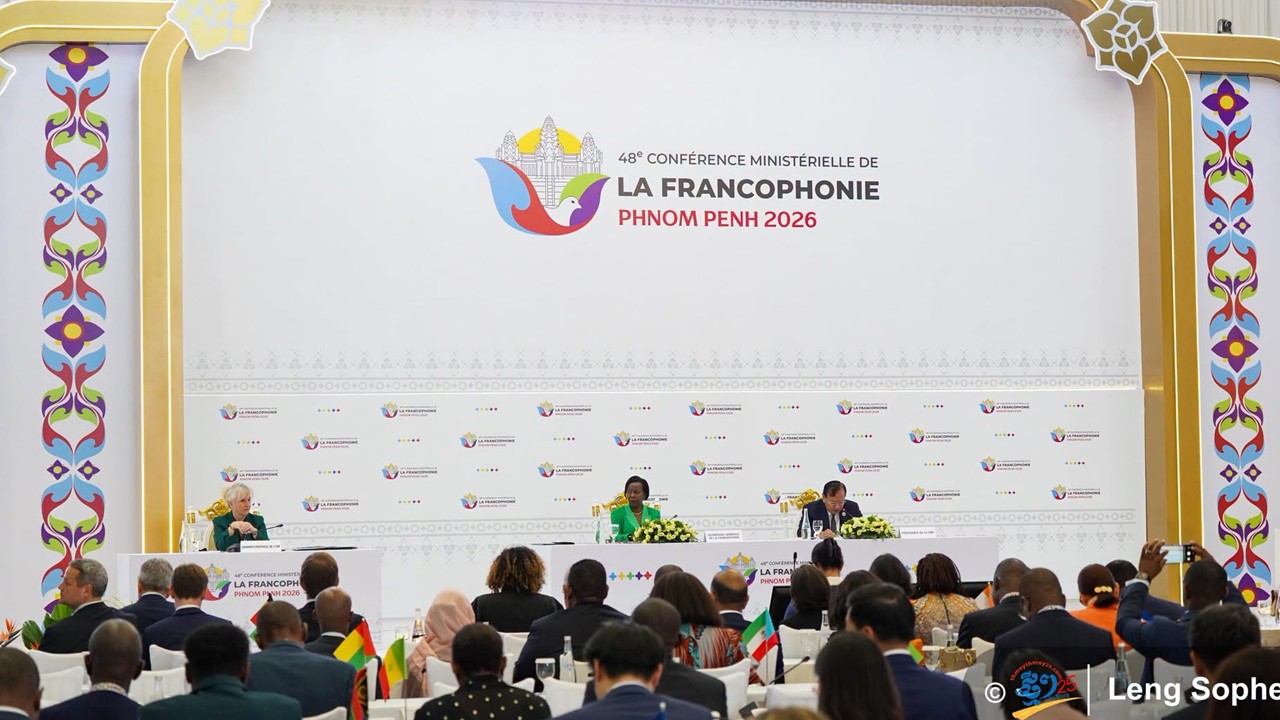
PHNOM PENH – Cambodia has chaired the 48th session of the Ministerial Conference of La Francophonie, completing preparations for a series of political, cultural and institutional documents that will be presented to world leaders at the 20th Francophonie Summit on November 15–16.
Deputy Prime Minister and Foreign Minister Prak Sokhonn led Saturday's meeting, which brought together representatives of the International Organisation of La Francophonie (OIF) to review the organisation's priorities and finalise draft documents for consideration by heads of state and government.
Among the principal outcomes prepared for the summit are the proposed Phnom Penh Declaration, a resolution addressing crisis situations, pathways out of crises and peace consolidation across the French-speaking world, and the Phnom Penh Appeal on the protection of cultural heritage and promotion of cultural diversity.
The documents are expected to establish a common political direction for the organisation while reinforcing its role in conflict prevention, international cooperation and sustainable development.
According to Cambodia's Information Minister Neth Pheaktra, the ministerial conference concluded on Saturday after completing key documents and recommendations for submission to the summit. He said discussions had focused on maintaining peace, preventing conflicts and strengthening the Francophonie's contribution to addressing challenges faced by member countries.
Prak Sokhonn also emphasised the importance of resolving conflicts through international law, arguing that peace requires sustained commitment rather than being treated as an outcome that can be taken for granted.
Cultural heritage and artificial intelligence on agenda
Cambodia has also used its presidency of the ministerial conference to promote greater attention to cultural heritage and linguistic diversity, alongside the implications of digital technology and artificial intelligence for young people and economic development.
The proposed Phnom Penh Appeal seeks to establish a shared commitment among member countries to protect, preserve and promote their cultural heritage, recognising the importance of cultural identity within an increasingly interconnected world.
The discussions on artificial intelligence and digital development reflect the organisation's wider ambition to ensure French-speaking countries can participate more effectively in the global digital economy, particularly through education, innovation and entrepreneurship.
The summit's theme, Reinvesting in Peace for Shared Prosperity and Lasting Stability, reflects Cambodia's intention to place peacebuilding at the centre of discussions on economic development and international cooperation.
Leadership transition and international tensions
The Phnom Penh gathering also comes at an important moment for the OIF, which represents 90 member states and governments, comprising 53 full members, five associate members and 32 observers.
One of the most significant decisions facing leaders on November 16 will be the election of the organisation's secretary-general for the 2027–2030 term.
The leadership contest has attracted attention following a diplomatic disagreement involving Rwanda and the Democratic Republic of Congo (DRC). Rwanda's incumbent Secretary-General Louise Mushikiwabo is seeking a third term, while the DRC had initially nominated Juliana Lumumba.
However, the DRC announced on Saturday that it was withdrawing Lumumba's candidacy and supporting former Romanian prime minister Dacian Ciolos, in an effort to build consensus around what it described as a unifying candidate.
The dispute is particularly sensitive because the DRC has accused Rwanda of supporting armed groups operating in eastern Congo, allegations that Kigali denies. Kinshasa has also threatened to withdraw from the organisation if Mushikiwabo is re-elected.
The leadership question is taking place against a broader debate about the organisation's political role, following the withdrawal of Mali, Niger and Burkina Faso in 2025 after disagreements over their suspensions following military coups.
Cambodia's growing multilateral role
Hosting the 20th Francophonie Summit represents a significant diplomatic milestone for Cambodia, which is welcoming the organisation's highest-level gathering for the first time.
The summit is also the first to be held in Southeast Asia since Vietnam hosted the event in Hanoi in 1997.
Cambodia's historical association with the Francophonie dates back to its late King Norodom Sihanouk, one of the founding figures of the organisation's predecessor, the Agency for Cultural and Technical Cooperation, established in 1970. Cambodia joined the OIF as an observer in 1991 before becoming a full member in 1993.
According to Cambodia's Information Ministry, delegations from 82 of the organisation's 90 member countries and governments are attending the Phnom Penh gathering, alongside substantial international media representation.
Beyond the formal summit, Cambodia is hosting the Village de la Francophonie, cultural exhibitions and FrancoTech, an innovation and technology event bringing together businesses, institutions and start-ups.
The ministerial conference's recommendations will now go before the heads of state and government, who are expected to adopt the Phnom Penh Declaration and the resolution on crisis response and peace consolidation before concluding the summit on November 16.
The outcome will help define the organisation's priorities as it seeks to maintain its relevance as a platform for diplomatic dialogue, cultural cooperation and economic engagement across five continents.